Algebra · Structure and symmetry

Algebra

From solving equations to studying the structures behind them: groups, rings, fields and the symmetries that organize everything from crystals to cryptography. Wear it on button-ups and socks, with a mathematics tie to match.

Behind this page a wallpaper builds itself. It starts from one motif, a Greek zeta in its fundamental domain, and as you scroll the symmetries of a wallpaper group are applied to it in order of word length: each new tile is its parent reflected across its own edge or turned about its own corner, and then the lattice copies that patch outward ring by ring until the plane is covered. Each big idea on the page has its own group. The intro builds p1, translations only. Groups builds p4 and labels its tiles e, r, r squared, r cubed: each tile is one element of the group. Lagrange’s theorem builds p6m and colors it by the cosets of the subgroup of turns by 120 degrees: the 12 tiles around each six-fold center fall into 4 cosets of 3. Galois theory builds p4m, whose 8 point symmetries move the four roots of x to the fourth minus 2, which sit on a square, exactly as the Galois group D4 does. Rings and fields shows the Gaussian integers modulo 2 plus i: five cosets that form the field with five elements, and crosses that tile the plane, a perfect error-correcting code. The fundamental theorem of algebra builds p6 and marks the roots of z to the n equals 1 at its 6-, 3- and 2-fold centers. Eigenvalues builds p3 and shows the crystallographic restriction: a turn that keeps a lattice has an integer trace, 2 cos theta, so only 1-, 2-, 3-, 4- and 6-fold turns tile, and three regular pentagons leave a 36 degree gap. The page ends on all 17 wallpaper groups, each generated from the same motif and named in Conway’s orbifold notation; every one was classified from its construction.

Why it matters

See a symmetry, reach for a group

Algebra began as the art of solving equations and became the study of structure itself. Its name comes from al-jabr, “restoration,” in the title of the book Muhammad ibn Musa al-Khwarizmi wrote in Baghdad around 820. In 1545 Gerolamo Cardano published solutions to the cubic and quartic, and then progress stalled at the quintic. Niels Henrik Abel proved in 1824 that no general formula in radicals exists, and Évariste Galois, killed in a duel in 1832 at the age of twenty, showed why: the answer lies in a group of symmetries of the roots.

Algebraists learn to ask not what an object is but what it does, and which maps preserve that. They draw commutative diagrams, chase elements through exact sequences, and feel real pleasure when two structures from different corners of mathematics turn out to be isomorphic. They test conjectures on thousands of cases with computer algebra systems, and they know the landmarks: the classification of finite simple groups, spread across tens of thousands of journal pages, and the Monster, the largest of the sporadic groups it turned up, with roughly 8 × 10⁵³ elements.

MAGIC THEOREM

A floor, a zipper, a kaleidoscope and a propeller, each priced by one theorem.

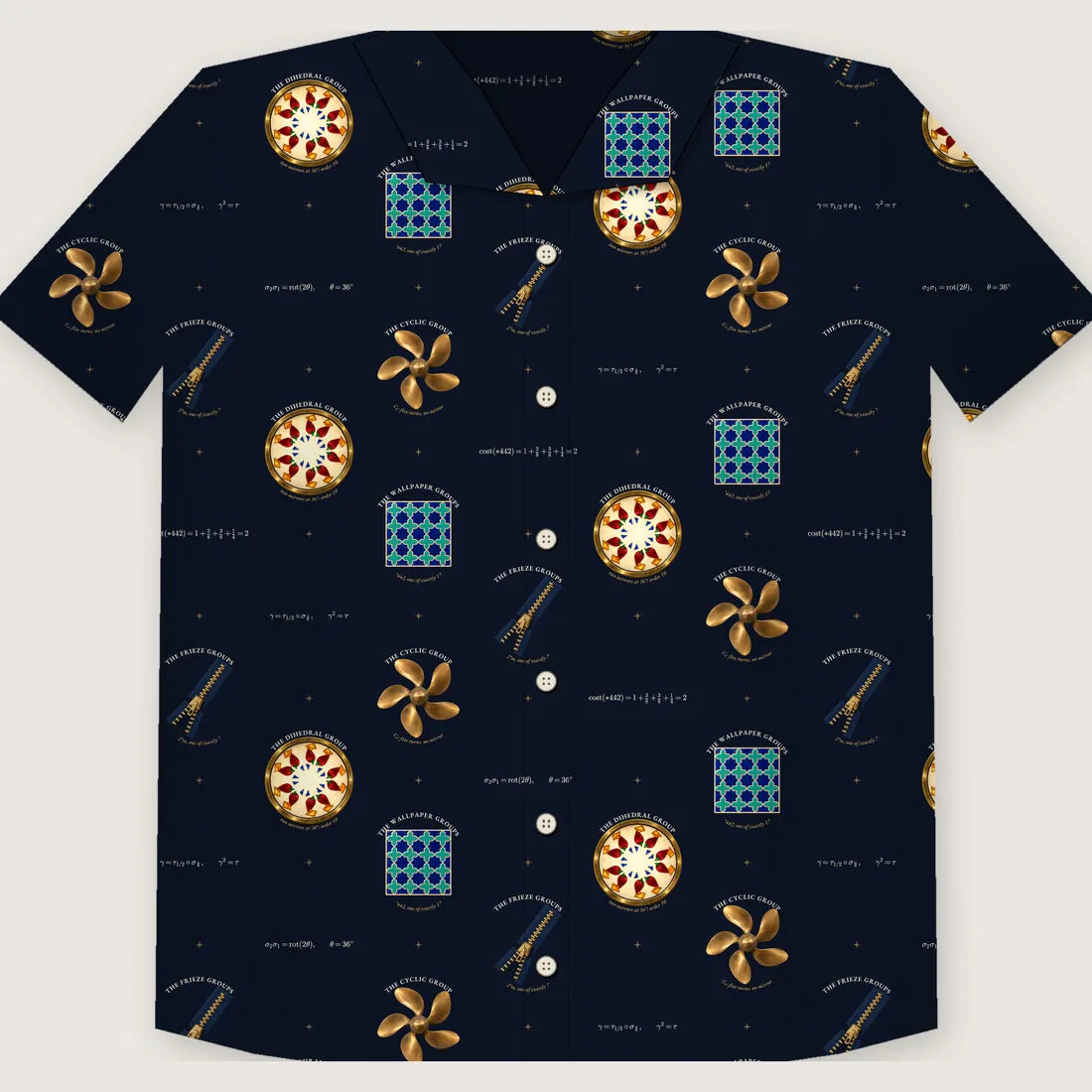
Conway’s orbifold notation writes any pattern’s symmetry as a short signature, and his Magic Theorem prices it: the features of a pattern that fills a plane or a strip cost exactly 2, and those of a finite figure cost 2 − 2/|G|, which gives its order. A tiled floor is *442, a zipper 2*∞, a kaleidoscope *55 and a propeller 55: four signatures, four sums.

  • The Wallpaper GroupsA square panel of glazed tiles in the star-and-cross pattern: cobalt eight-pointed stars tip to tip, turquoise crosses between them, cream grout.
  • The Frieze GroupsA heavy brass zipper on indigo cotton tape, closed for most of its length, the two rows of elements parting below the slider.
  • The Dihedral GroupThe view through a two-mirror kaleidoscope: a ruby teardrop, an amber shard, a cobalt shard and a green sliver, each seen ten times.
  • The Cyclic GroupA polished five-bladed manganese-bronze propeller seen along the shaft, every blade skewed the same way.
Tell me when it’s ready

Leave your email and we’ll write the day it’s ready.
CYCLOTOMY

Dividing the circle, and what each n allows.

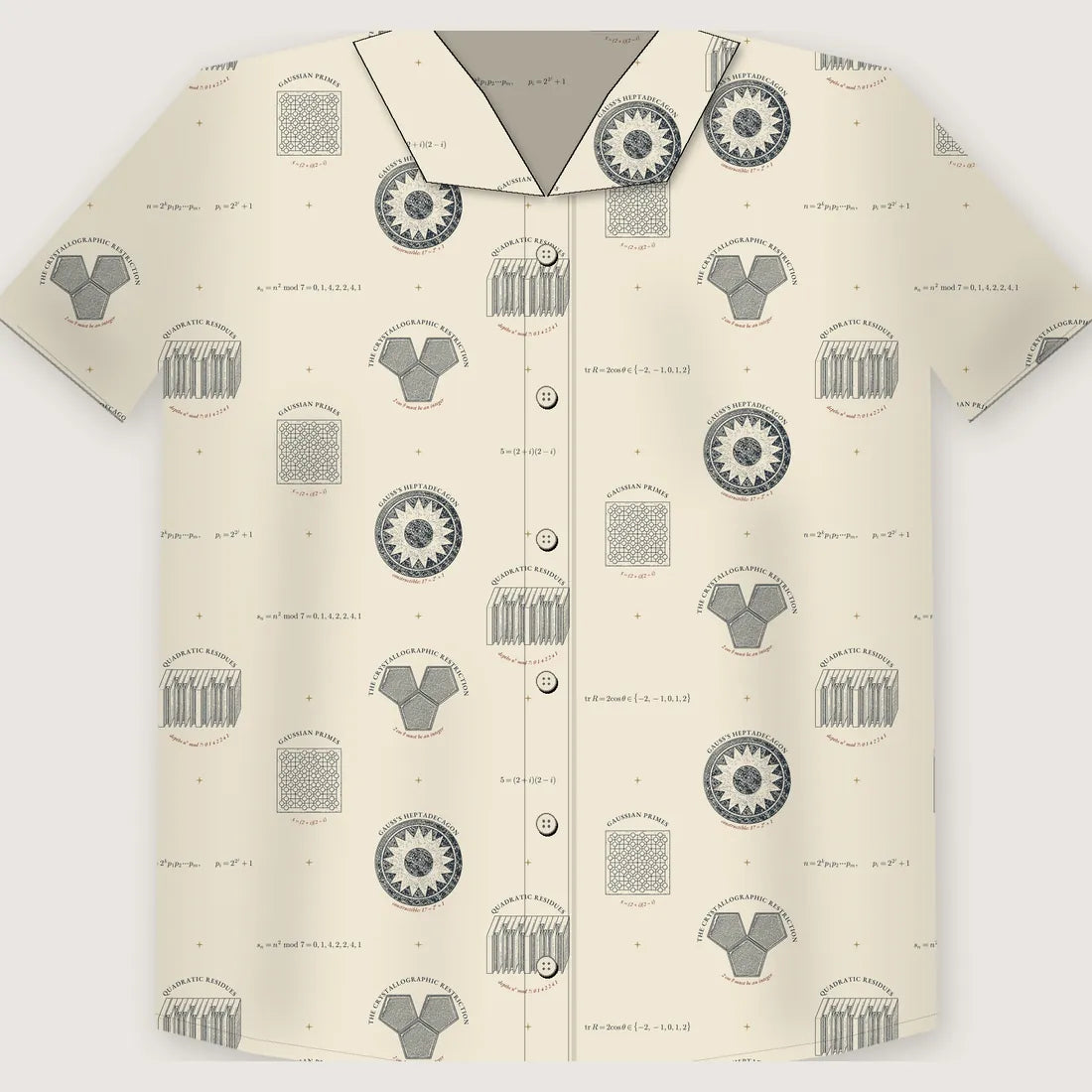
Cyclotomy, Gauss’s division of the circle, is arithmetic in the cyclotomic integers ℤ[ζn], and each object here is one case. The 17-gon can be drawn because φ(17) = 16 is a power of two; the diffuser scatters evenly because a Gauss sum has size √p; the Gaussian primes live in ℤ[i] = ℤ[ζ4]; and a lattice allows an n-fold turn only when φ(n) ≤ 2.

  • Gauss’s HeptadecagonA gilt-brass 17-pointed star inlaid in a dark green marble roundel, a brass ring through its 17 tips.
  • Quadratic ResiduesA hardwood quadratic-residue diffuser of 14 wells between thin fins, their depths 0, 1, 4, 2, 2, 4, 1 twice over.
  • Gaussian PrimesA 13 × 13 kaya-wood Go board with 64 white shell stones on the Gaussian primes and the center point empty.
  • The Crystallographic RestrictionThree identical cobalt-glazed regular pentagonal tiles meeting at one point, edge to edge, with the empty 36° wedge pointing straight up.
Tell me when it’s ready

Leave your email and we’ll write the day it’s ready.

AL-JABR

Equations of degree one to four, from counting rods to Galois.

Algebra takes its name from al-jabr, “restoring”: al-Khwarizmi’s step of moving a subtracted term to the other side of an equation. He solved the quadratics themselves geometrically, filling in the missing corner of a square. This design climbs the degrees: a linear system on a Han counting board, a quadratic completed to a square in Baghdad, the Delian cubic that straightedge and compass cannot reach, and the quartic x4 − 2, whose symmetries Galois matched with its fields.

  • Gaussian EliminationA dark wooden counting board ruled into three columns and four rows, the twelve numbers of the problem laid out in red-lacquered counting rods.
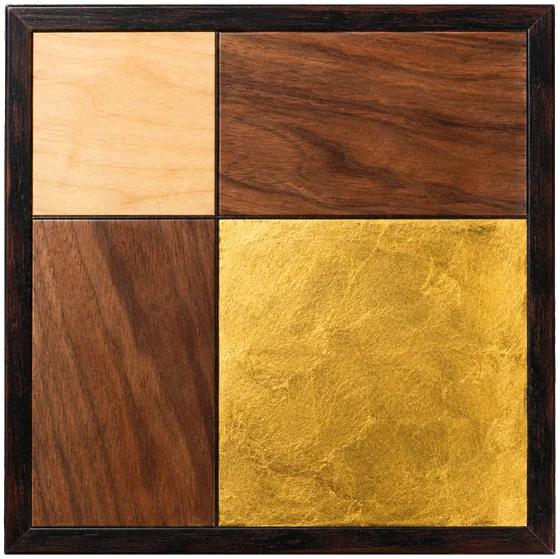
  • Completing the SquareA square inlaid board: a pale maple square x by x, two walnut rectangles 5 by x, and the gilded 5 by 5 corner square that completes it.
  • Doubling the CubeTwo blocks of white marble, both perfect cubes, side by side on one floor in the same orientation, the larger edge 1.26 times the smaller.
  • The Galois LatticeThe subgroup lattice of D₄ in glass spheres and brass rods, 1, 3, 5 and 1 spheres joined by 15 rods, standing on a black mirror whose reflection is the lattice of fields.
Tell me when it’s ready

Leave your email and we’ll write the day it’s ready.

Socks mix and match across every field: three pairs for $69, and two ship free in the U.S.

Crew socks · One size

Crew socks

A field of your own, from cuff to toe.

  • The pattern
  • The previewA studio mockup; photos of the finished pair are on the way.
Shop now · Regular price $26 Sale price $23.40

Leave your email and we’ll write the day this pair is ready.

Necktie · 3.5 in wide

Subject ties

A formal introduction to your field.

  • The color
  • The previewStudio render of the tie. Zoom shows the print up close.
Shop now · Regular price $36 Sale price $32.40

Leave your email and we’ll write the day this tie is ready.

The science on the shirt

What you’re wearing

Every object on the shirts, and the science behind it.

The Wallpaper Groups

MAGIC THEOREM

The Wallpaper Groups

*442, one of exactly 17

Symmetry people name a floor’s group before they notice its color, and this is the floor every book on Islamic pattern opens with.

The Frieze Groups

MAGIC THEOREM

The Frieze Groups

2*∞, one of exactly 7

Glide reflections are the symmetry students miss; once shown on a zipper they see them on every jacket, which suits an apparel brand.

The Dihedral Group

MAGIC THEOREM

The Dihedral Group

two mirrors at 36°: order 10

It is the first group anyone can hold to the eye, and the cleanest proof that two reflections make a rotation.

The Cyclic Group

MAGIC THEOREM

The Cyclic Group

C₅: five turns, no mirror

Chirality made of bronze: the standard example of a shape with rotations and no reflections, and of left and right as a group-theoretic fact.

Gauss’s Heptadecagon

CYCLOTOMY

Gauss’s Heptadecagon

constructible: 17 = 2⁴ + 1

It is the discovery that made Gauss choose mathematics, and the cleanest case of Galois theory settling a question of geometry.

Quadratic Residues

CYCLOTOMY

Quadratic Residues

depths n² mod 7: 0 1 4 2 2 4 1

Acousticians hang these panels in studios and concert halls, and number theorists are delighted to find a Gauss sum on the wall.

Gaussian Primes

CYCLOTOMY

Gaussian Primes

5 = (2 + i)(2 − i)

Number theorists know this snowflake of primes on sight, and Go players will want to count the stones.

The Crystallographic Restriction

CYCLOTOMY

The Crystallographic Restriction

2 cos θ must be an integer

Every crystallography course proves it in four lines on the board; every tiler has learned it from the gap.

Gaussian Elimination

AL-JABR

Gaussian Elimination

Nine Chapters: 9¼, 4¼, 2¾

Linear algebra students are taught Gauss’s name for it; finding the method on a counting board some 1,500 years earlier is the surprise.

Completing the Square

AL-JABR

Completing the Square

x² + 10x = 39, so x = 3

It is the first proof anyone sees that algebra is geometry in disguise, and the word on the page comes from it.

Doubling the Cube

AL-JABR

Doubling the Cube

degree 3, not a power of 2

A two-thousand-year-old question settled by one line about degrees: the standard first use of the tower law.

The Galois Lattice

AL-JABR

The Galois Lattice

x⁴ − 2: 10 subgroups ↔ fields

Every Galois theory course works this example; drawing the two lattices, one upside down, is the moment the theorem makes sense.

The big ideas

What people in algebra carry around

Groups

A set with an associative operation, an identity and inverses. The mathematics of symmetry, from the Rubik’s Cube to particle physics.

Lagrange’s Theorem

In a finite group, the order of any subgroup divides the order of the group. Small, early, and endlessly useful.

Galois Theory

Matches the fields between an equation’s coefficients and its roots with subgroups of a symmetry group. It explains why the quintic resists.

Rings and Fields

Structures where you can add and multiply; in a field you can also divide. Finite fields run error-correcting codes and cryptography.

The Fundamental Theorem of Algebra

Every non-constant polynomial has a complex root, so a degree-n polynomial has exactly n roots, counted with multiplicity.

Eigenvalues and Eigenvectors

Directions a linear map only stretches. They find vibration modes, rank web pages and give the possible outcomes of quantum measurements.

Shop Algebra: Wear it to work

Made to order for you · free U.S. shipping on $46+ (shirts, ties and socks) · 10% off through 30 Nov

More Algebra designs are on the way.

Leave your email and we’ll write the day they’re ready.