
Technology · Knowledge put to work
Technology
The practical side of knowledge: from the printing press to the transistor, how ideas become tools, and tools reshape what people can do.
Includes footage courtesy NASA/JPL-Caltech
Behind this page one letter is followed down the stack of abstraction, level by level. The problem: shout “hello”. The algorithm: in ASCII a lower-case letter and its capital differ only in bit 5, worth 32, so clear it. The C program, and its RISC-V machine code, run here on “hello!” to give “HELLO!”; the instruction andi t0, t0, -33 is the word 0xFDF2F293. The ALU ANDs 0x68 with 0xFFFFFFDF to get 0x48. Bit 5 is an AND gate built from six CMOS transistors; with inputs 1 and 0 the inverter’s n-channel transistor is on and pulls the bit to 0 volts, through a channel of electrons in silicon, whose crystal has a lattice constant of 5.431 angstroms. At the end the whole stack stands, with each neighboring field at the level where it lives.
Why it matters
For the one everyone calls when it breaks
Technology is neither good nor bad; nor is it neutral.Melvin Kranzberg, 1986
Technology is knowledge made to work, reliably, for people who never need to see the theory. Its history is full of quiet thresholds. Just before Christmas 1947, John Bardeen and Walter Brattain showed colleagues at Bell Labs a point-contact transistor: a sliver of germanium touched by two gold contacts. In 1965 Gordon Moore noticed that the number of components on a chip was doubling every year; in 1975 he revised that to every two years, and an industry spent the next half-century keeping to his schedule.
Working in it means living between the old and the new: keeping a twenty-year-old system alive while learning the tool that will replace it. It means release notes, standards documents and backward compatibility, the root cause that turns out to be a loose connector, and the satisfaction of a system that runs so well that nobody remembers it exists. Technologists learn that most progress is incremental, that the demo is not the product, and that temporary fixes have a way of becoming permanent.
Shop Technology: One from every corner of technology
Made to order for you · free U.S. shipping on $46+ (shirts, ties and socks) · 10% off through 30 Nov
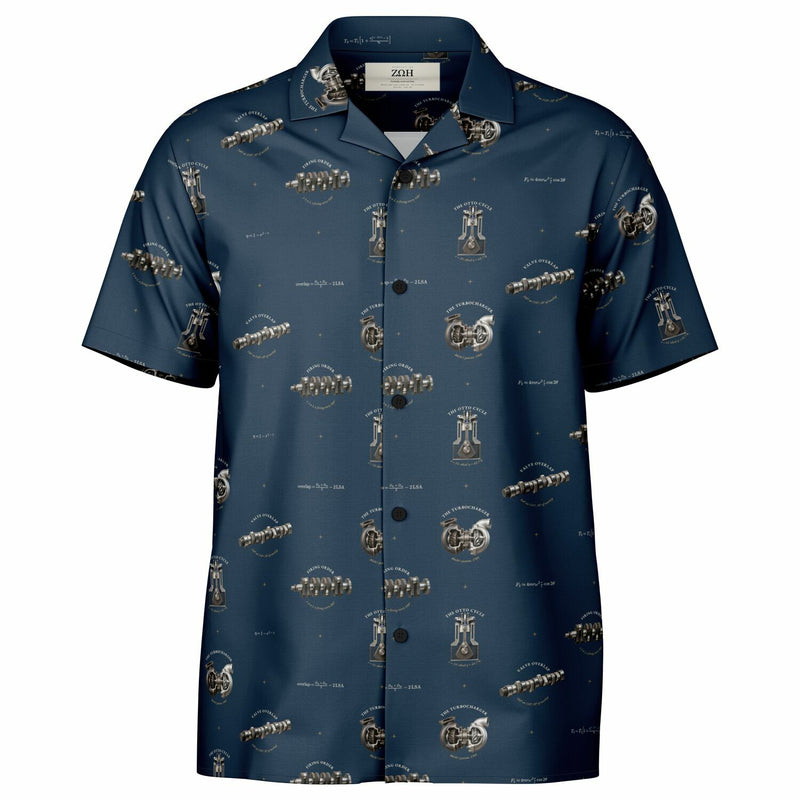
 Full Stack Button-Up
Short-sleeve button-up · XS–4XL · 3 styles
 AI & Machine Learning Equation Windowpane Button-Up · Signal Fog
Short-sleeve button-up · XS–4XL


Each one is knitted to order. Most arrive two to four weeks after ordering. Ordered now, it will most likely arrive after Christmas, just in time for a cozy New Year.
Ugly-sweater day for the whole team? Write to us by 24 November and we’ll help you sort sizes and get everyone’s order in before the Christmas cutoff.
 Hyperspectral Button-Up
Short-sleeve button-up · XS–4XL · 3 styles
 Below Threshold Button-Up · Midnight · Smaller print
Short-sleeve button-up · XS–4XL


More Technology designs are on the way.
Leave your email and we’ll write the day they’re ready.
The big ideas
What people in technology carry around
Abstraction Layers
Each layer hides the one beneath: transistors, gates, processors, operating systems, applications. Nobody has to understand everything at once.
Backward Compatibility
New systems that still run what came before. Expensive and unglamorous, and the reason decades-old files still open.
Technical Standards
Shared specifications such as TCP/IP, USB and Wi-Fi let rival makers’ parts work together. The internet is mostly agreements.
Moore’s Law
Transistor counts per chip doubled roughly every two years for decades: an observation, and then a target the industry chose to hit.
The Transistor
A semiconductor switch and amplifier. Bardeen, Brattain and Shockley shared the 1956 Nobel Prize.
Timeline
Who came before
105
Cai Lun
d. 121
Presented to Emperor He paper made from bark, hemp waste, old rags and fishing nets
132
Zhang Heng
78–139
A seismoscope for the Han court that marked the direction of a distant earthquake
Geology, for Zhang Heng1041–48
Bi Sheng
fl. 1041–48
Movable type of fired clay, as described by Shen Kuo in Mengxi bitan
1454–55
Johannes Gutenberg
c. 1400–1468
The 42-line Bible, printed in Mainz with movable metal type
1642–45
Blaise Pascal
1623–1662
The Pascaline, a geared calculator for addition and subtraction
Computer Science, for Blaise Pascal1656
Christiaan Huygens
1629–1695
A clock regulated by a pendulum, built to his design by Salomon Coster
Classical Mechanics, for Christiaan Huygens1804–05
Joseph Marie Jacquard
1752–1834
A loom mechanism whose pattern is set by a chain of punched cards
Computer Science, for Joseph Marie Jacquard1822
Charles Babbage
1791–1871
The Difference Engine, proposed to compute and print mathematical tables
Computer Science, for Charles Babbage1843
Ada Lovelace
1815–1852
Notes on the Analytical Engine; Note G sets out the steps to compute Bernoulli numbers
Computer Science, for Ada Lovelace1844
Samuel Morse
1791–1872
“What hath God wrought,” sent by telegraph from the Capitol to Baltimore
Electrical Engineering, for Samuel Morse1854
George Boole
1815–1864
An Investigation of the Laws of Thought: logic written as algebra
Algebra, for George Boole1876
Alexander Graham Bell
1847–1922
US patent 174,465: vocal sounds transmitted by an undulating electric current
Electrical Engineering, for Alexander Graham Bell1888
Heinrich Hertz
1857–1894
Electromagnetic waves generated and detected in the laboratory
Electricity & Magnetism, for Heinrich Hertz1947
John Bardeen and Walter Brattain
1908–1991 · 1902–1987
The point-contact transistor, at Bell Telephone Laboratories
Electrical Engineering, for John Bardeen and Walter Brattain1948
Claude Shannon
1916–2001
A Mathematical Theory of Communication: information measured in bits
Computer Science, for Claude Shannon1952
Grace Hopper
1906–1992
The A-0 compiling routine: UNIVAC I programs assembled from a subroutine library
Computer Science, for Grace Hopper1958
Jack Kilby
1923–2005
An integrated circuit: an oscillator built in a single piece of germanium
Electrical Engineering, for Jack Kilby
Neighboring fields
Wander next door
Stay close: Hear when the next technology field opens
Made to order for you · free U.S. shipping on $46+ (shirts, ties and socks) · 10% off through 30 Nov
New fields open one at a time.
Leave your email and we’ll write when the next one opens. About once a month, never more.