KUNSTFORMEN
Haeckel’s art forms, with the geometry that forces them.
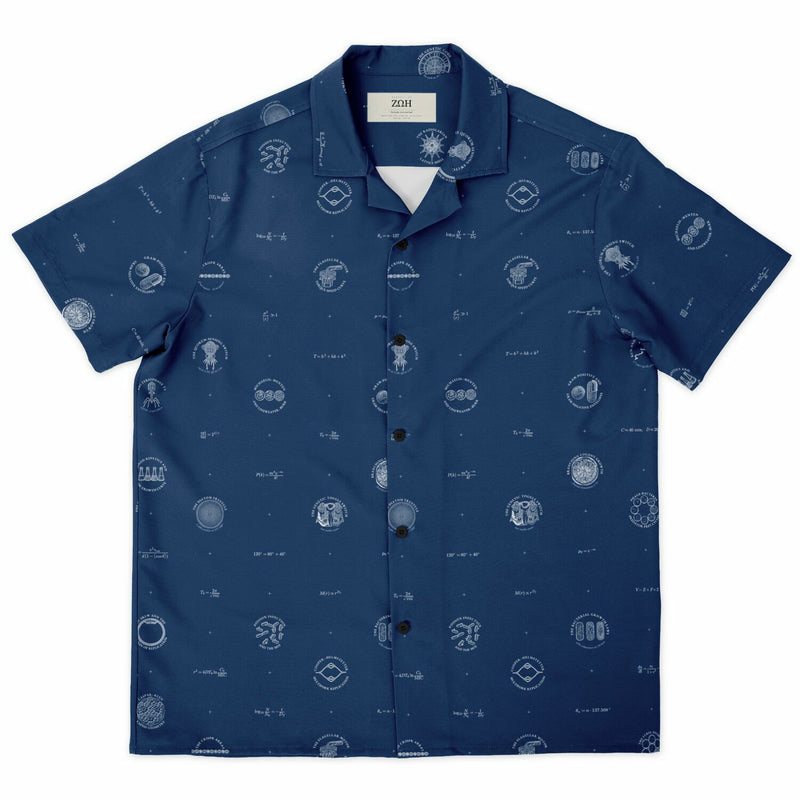
Haeckel described more than three thousand new radiolarian species from the Challenger samples, and Kunstformen der Natur made their glass skeletons famous. The explanation took longer than the admiration. In 1917 D’Arcy Thompson pointed out that Haeckel’s Aulonia, drawn as a sphere of regular hexagons, could not be exact: Euler’s formula demands the equivalent of twelve pentagons. The same twelve turn up in viruses. In 1962 Caspar and Klug showed how copies of one protein close a capsid, pentamers at the vertices and hexamers everywhere else, and capsid architecture became arithmetic.
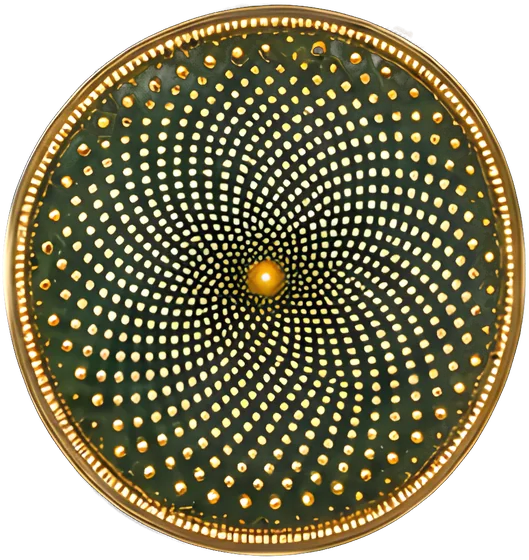
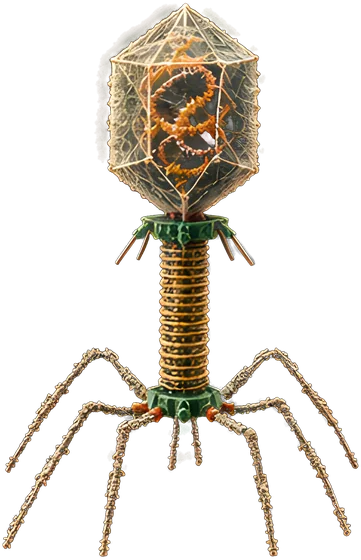
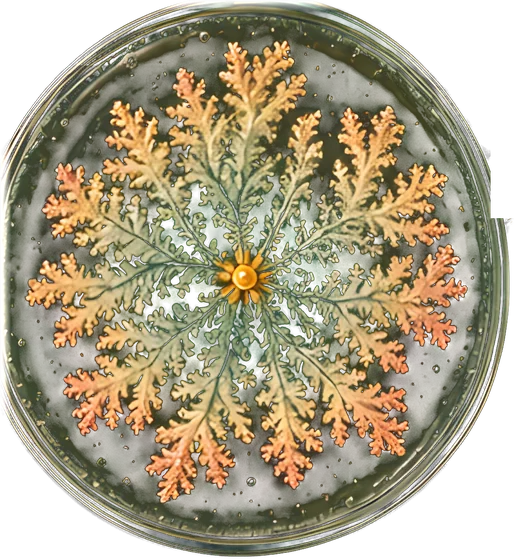
The diatom’s frustule is glass as well, two valves nested like the halves of a Petri dish, so every division leaves one daughter smaller; diatoms do something like a fifth of Earth’s photosynthesis. T4 was the phage group’s workhorse: Benzer mapped the fine structure of a gene in its rII region, and Crick and Brenner used its mutants in 1961 to show that the code is read in triplets. And in 1989 Fujikawa and Matsushita showed that Bacillus subtilis, starved on hard agar, branches with the fractal dimension of diffusion-limited aggregation, about 1.7.
Leave your email and we’ll write the day it’s ready.