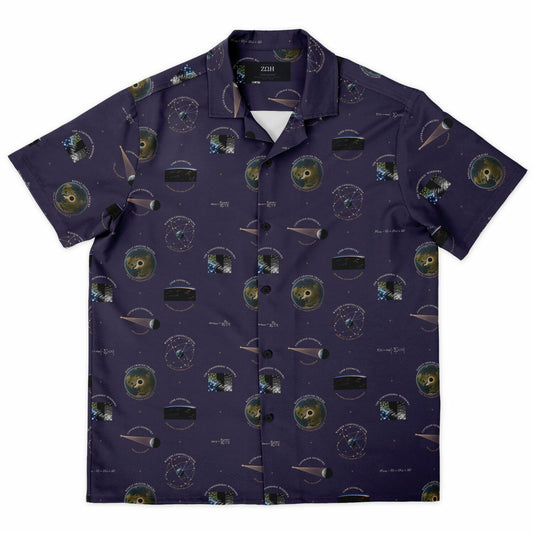
Digital mockup; photos of the finished piece are coming.
300 Kelvin Button-Up · Ironbow · Smaller print
300 Kelvin Button-Up · Ironbow · Smaller print
The infrared engineer’s world, where everything warm glows and the detector must be colder.
Free U.S. shipping on every shirt.
Grand opening: the 10% is already taken off the price shown. Through 30 November.
| Inches | XS | S | M | L | XL | 2XL | 3XL | 4XL |
|---|---|---|---|---|---|---|---|---|
| Chest, flat | 20 | 21 | 22 | 23 | 24½ | 26¾ | 29 | 31¼ |
| Front length | 28½ | 29 | 29½ | 30 | 30¾ | 32 | 33 | 34 |
| Shoulder | 17¾ | 18¼ | 18¾ | 19¼ | 20 | 21⅛ | 22¼ | 23⅜ |
| Sleeve length | 8¼ | 8½ | 8¾ | 9 | 9¼ | 9⅝ | 10 | 10⅜ |
| cm | XS | S | M | L | XL | 2XL | 3XL | 4XL |
|---|---|---|---|---|---|---|---|---|
| Chest, flat | 50.8 | 53.3 | 55.9 | 58.4 | 62.2 | 67.9 | 73.7 | 79.4 |
| Front length | 72.4 | 73.7 | 74.9 | 76.2 | 78.1 | 81.3 | 83.8 | 86.4 |
| Shoulder | 45.1 | 46.4 | 47.6 | 48.9 | 50.8 | 53.7 | 56.5 | 59.4 |
| Sleeve length | 21.0 | 21.6 | 22.2 | 22.9 | 23.5 | 24.4 | 25.4 | 26.4 |
Measured with the shirt laid flat; chest is taken 1 in below the armhole, so double it for the full chest. The easiest check: lay a shirt that fits you flat and compare. Each shirt is cut and sewn by hand, so sizes can vary by up to 1 in. Stretch fabric (12% spandex).
Buying for someone? Compare a shirt they wear with this chart, or choose socks or a tie, which are one size. Or give a gift card and let them choose.
Still unsure? Ask us.
Couldn't load pickup availability
Also from Space Sensing
-
The tieOrbital Observer Medallion Tie · False-Color Lagoon
Regular price $36Sale price $32.40 -
The socksGolden Hour in Orbit Socks · Concept Medallions · Orbital Night
Regular price $26Sale price $23.40


The story in the print
Max Planck’s formula of 1900 began as an interpolation that fitted the Berlin cavity measurements, and justifying it forced him to quantize energy. Its peak gives Wien’s constant, 2897.77 µm K, and every sensor band follows from it: the Sun at 5,800 K peaks at 0.50 µm, where eyes and silicon work, and a 300 K world peaks at 9.66 µm, which is why thermal imagers live in the 8 to 12 µm window. That warm world is also the problem. An infrared detector counts background photons along with its signal, and their shot noise caps its detectivity; for a 300 K hemisphere the BLIP limit bottoms out at 4.63 × 10¹⁰ Jones, and only a cold shield, which lets the chip see less, gets past it.
Scanning decides how long each pixel is watched. From 500 km the ground slides by at 7.06 km/s, so a whiskbroom’s single detector gets 0.47 µs per pixel across a 30 km swath, while a pushbroom line array keeps every pixel for the full 1.42 ms, 54.8 times the signal-to-noise when shot noise dominates. Landsat made that change in public, from the Thematic Mapper’s scan mirror to the pushbroom arrays of the Operational Land Imager on Landsat 8. Every infrared pixel also has its own gain and offset, cleared by viewing a uniform source at two temperatures. And from space the Earth is not one blackbody: in the 15 µm carbon dioxide band it radiates from the cold tropopause, the greenhouse effect as a picture.
The five images:
- Planck’s Law and Wien’s Displacement: Four identical spheres at 5,800, 1,500, 800 and 300 K, in computed blackbody color: white, orange, cherry red, and not glowing at all.
- The BLIP Limit: A cutaway dewar: warm photons raining in from every direction, and one f/2 cone, 28 degrees across, reaching the cold chip.
- Whiskbroom, Pushbroom and Staring: Three infrared chips with one pixel size: a single pixel under a scan mirror, one line of pixels, and a staring block.
- Non-Uniformity Correction: A thermal image of a mug of tea split down the middle: column stripes on the raw half, clean after two-point correction.
- Earth’s Outgoing Longwave Spectrum: The whole Earth in its own heat, halved: at 10 µm warm seas and cold storm tops, at 15 µm a dim, featureless glow.
This button-up carries 300 KELVIN at the smaller print scale. Each image is explained above. It is made for people who have run a link budget, calibrated a focal plane and waited for a clear pass for a living or for a grade, and for anyone who likes to know what they are wearing.
Details: 88% polyester, 12% spandex stretch fabric, spread collar, short sleeves. Printed and sewn to order.
Fabric, care and how it’s made
- Fabric: 88% polyester, 12% spandex
- Fabric weight: 3.83 oz/yd² (130 g/m²)
- Care: machine wash cold, inside out. Do not bleach. Hang to dry. Iron on low.
- Made for adults.
- Made in USA of imported fabric.
- How it’s made: I design every template and check every figure; AI image tools help render the illustrations.
What’s on it The equations, ideas and images on this design, and what they mean
More from Space Sensing
-
Hyperspectral Button-Up
Regular price $65Regular price$65Sale price $58.50 -
Pretty Pictures Button-Up · Midnight
Regular price $65Regular price$65Sale price $58.50 -
First Light Button-Up · Midnight
Regular price $65Regular price$65Sale price $58.50 -
Nadir Button-Up · Ironbow
Regular price $65Regular price$65Sale price $58.50