Digital mockup; photos of the finished piece are coming.
B²FH Button-Up · Pale blue · Smaller print
B²FH Button-Up · Pale blue · Smaller print
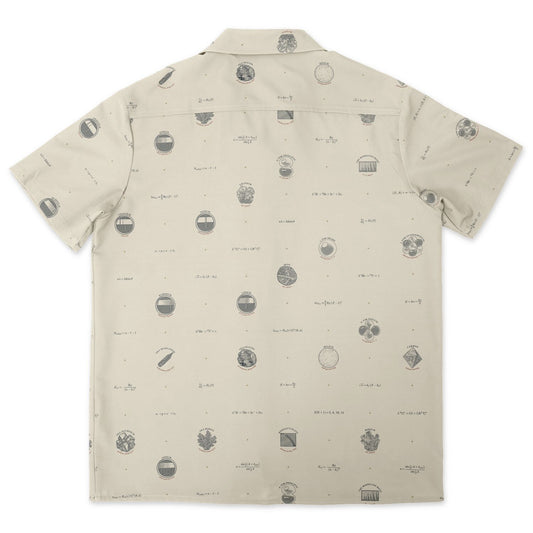
Where the elements come from, as Burbidge, Burbidge, Fowler and Hoyle sorted it out in 1957.
Free U.S. shipping on every shirt.
Grand opening: the 10% is already taken off the price shown. Through 30 November.
| Inches | XS | S | M | L | XL | 2XL | 3XL | 4XL |
|---|---|---|---|---|---|---|---|---|
| Chest, flat | 20 | 21 | 22 | 23 | 24½ | 26¾ | 29 | 31¼ |
| Front length | 28½ | 29 | 29½ | 30 | 30¾ | 32 | 33 | 34 |
| Shoulder | 17¾ | 18¼ | 18¾ | 19¼ | 20 | 21⅛ | 22¼ | 23⅜ |
| Sleeve length | 8¼ | 8½ | 8¾ | 9 | 9¼ | 9⅝ | 10 | 10⅜ |
| cm | XS | S | M | L | XL | 2XL | 3XL | 4XL |
|---|---|---|---|---|---|---|---|---|
| Chest, flat | 50.8 | 53.3 | 55.9 | 58.4 | 62.2 | 67.9 | 73.7 | 79.4 |
| Front length | 72.4 | 73.7 | 74.9 | 76.2 | 78.1 | 81.3 | 83.8 | 86.4 |
| Shoulder | 45.1 | 46.4 | 47.6 | 48.9 | 50.8 | 53.7 | 56.5 | 59.4 |
| Sleeve length | 21.0 | 21.6 | 22.2 | 22.9 | 23.5 | 24.4 | 25.4 | 26.4 |
Measured with the shirt laid flat; chest is taken 1 in below the armhole, so double it for the full chest. The easiest check: lay a shirt that fits you flat and compare. Each shirt is cut and sewn by hand, so sizes can vary by up to 1 in. Stretch fabric (12% spandex).
Buying for someone? Compare a shirt they wear with this chart, or choose socks or a tie, which are one size. Or give a gift card and let them choose.
Still unsure? Ask us.
Couldn't load pickup availability
Also from the Periodic Table
-
The tieElement of Style Medallion Tie · Verdigris Valence
Regular price $36Sale price $32.40 -
The socksThe Noble Set Socks · Concept Medallions · Carbon Standard
Regular price $26Sale price $23.40


The story in the print
In 1957 Margaret and Geoffrey Burbidge, William Fowler and Fred Hoyle published Synthesis of the Elements in Stars, a review that named eight processes building the elements and tied each to a stretch of the abundance curve. Hydrogen burning makes helium, as in the Sun. Helium burning makes carbon, three helium nuclei fusing through a resonance of carbon-12 at 7.65 MeV that Hoyle had predicted. The e process, burning near statistical equilibrium, builds the iron peak, which is why iron is so common in meteorites.
Beyond iron, nuclei grow by capturing neutrons. In the s process the captures are slow, and an unstable nucleus usually decays before the next one arrives; barium is its signature. In the r process they come so fast that nuclei run far beyond stability before decaying back. Uranium lies past bismuth, where the s process ends, so every uranium atom on Earth was made by the r process.
On the shirt:
- Helium: The Sun in white light, computed: limb darkening and granulation over the hydrogen burning that makes helium.
- Carbon: A natural diamond octahedron, uncut, four of its eight triangular faces showing.
- Iron: An etched slice of iron meteorite: the Widmanstätten pattern, nickel-iron lamellae in three directions 60° apart.
- Barium: A spray of honey-gold barite crystals, translucent blades with beveled ends.
- Uranium: Autunite in ordinary light: thin square plates of a uranium mineral, lemon-yellow, in book-like packets.
This button-up carries B²FH in Pale blue, printed edge to edge at the smaller print scale. It is made for people who have balanced, titrated and learned the table for a living or for a grade, and for anyone who likes to know what they are wearing.
Details: 88% polyester, 12% spandex stretch fabric, spread collar, short sleeves.
Fabric, care and how it’s made
- Fabric: 88% polyester, 12% spandex
- Fabric weight: 3.83 oz/yd² (130 g/m²)
- Care: machine wash cold, inside out. Do not bleach. Hang to dry. Iron on low.
- Made for adults.
- Made in USA of imported fabric.
- How it’s made: I design every template and check every figure; AI image tools help render the illustrations.
What’s on it The equations, ideas and images on this design, and what they mean
More from the Periodic Table
-
All the Elements Button-Up
Regular price $65Regular price$65Sale price $58.50 -
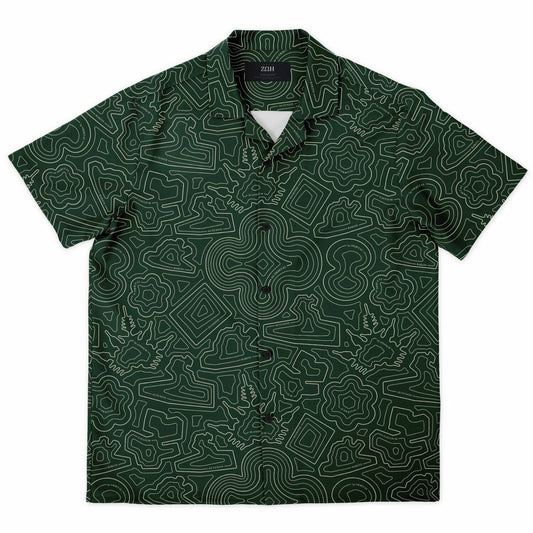
Elemental Terrain Button-Up · Malachite
Regular price $65Regular price$65Sale price $58.50 -
Left Blank Button-Up · Midnight · Smaller print
Regular price $65Regular price$65Sale price $58.50