Digital mockup; photos of the finished piece are coming.
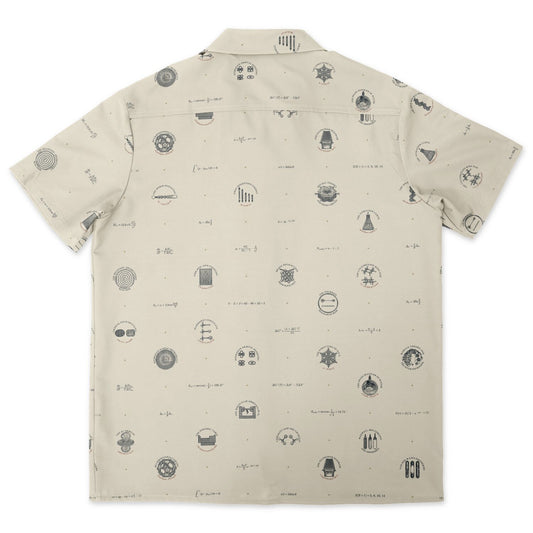
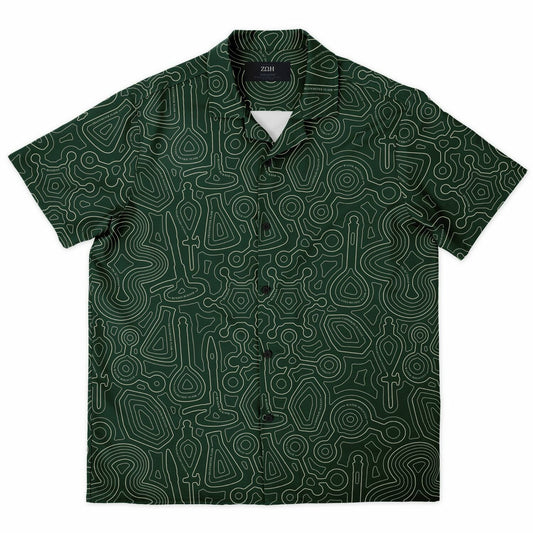
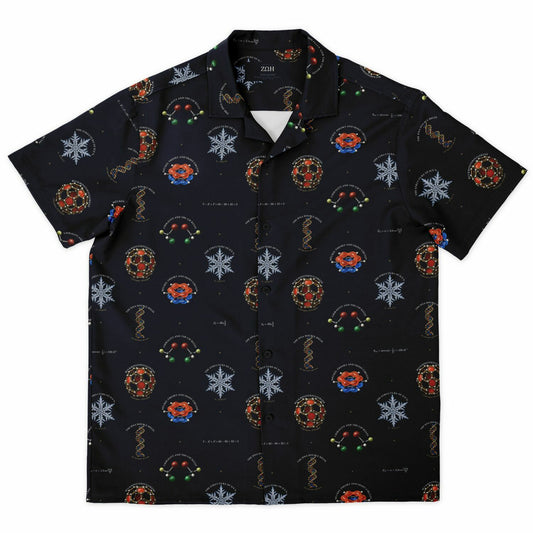
Double Dagger Button-Up · Copper sulfate · Smaller print
Double Dagger Button-Up · Copper sulfate · Smaller print
Rates, barriers, and the transition state nobody can bottle.
Large print only: Midnight.
Free U.S. shipping on every shirt.
Grand opening: the 10% is already taken off the price shown. Through 30 November.
| Inches | XS | S | M | L | XL | 2XL | 3XL | 4XL |
|---|---|---|---|---|---|---|---|---|
| Chest, flat | 20 | 21 | 22 | 23 | 24½ | 26¾ | 29 | 31¼ |
| Front length | 28½ | 29 | 29½ | 30 | 30¾ | 32 | 33 | 34 |
| Shoulder | 17¾ | 18¼ | 18¾ | 19¼ | 20 | 21⅛ | 22¼ | 23⅜ |
| Sleeve length | 8¼ | 8½ | 8¾ | 9 | 9¼ | 9⅝ | 10 | 10⅜ |
| cm | XS | S | M | L | XL | 2XL | 3XL | 4XL |
|---|---|---|---|---|---|---|---|---|
| Chest, flat | 50.8 | 53.3 | 55.9 | 58.4 | 62.2 | 67.9 | 73.7 | 79.4 |
| Front length | 72.4 | 73.7 | 74.9 | 76.2 | 78.1 | 81.3 | 83.8 | 86.4 |
| Shoulder | 45.1 | 46.4 | 47.6 | 48.9 | 50.8 | 53.7 | 56.5 | 59.4 |
| Sleeve length | 21.0 | 21.6 | 22.2 | 22.9 | 23.5 | 24.4 | 25.4 | 26.4 |
Measured with the shirt laid flat; chest is taken 1 in below the armhole, so double it for the full chest. The easiest check: lay a shirt that fits you flat and compare. Each shirt is cut and sewn by hand, so sizes can vary by up to 1 in. Stretch fabric (12% spandex).
Buying for someone? Compare a shirt they wear with this chart, or choose socks or a tie, which are one size. Or give a gift card and let them choose.
Still unsure? Ask us.
Couldn't load pickup availability
Also from Chemistry
-
The tieReaction Time Medallion Tie · Permanganate Potion
Regular price $36Sale price $32.40 -
The socksNoble Company Socks · Concept Medallions · Carbon After Dark
Regular price $26Sale price $23.40


The story in the print
The double dagger marks a transition state, the top of the barrier between reactant and product, a structure that cannot be isolated and has to be reasoned about. Arrhenius wrote down the temperature dependence of rates in 1889 as an empirical fit, and Maxwell’s distribution of molecular speeds explains it: only molecules in the high-energy tail react, and the tail grows exponentially with temperature while the peak barely moves. A reaction that doubles its rate for every ten degrees near room temperature has an activation energy of about 53 kJ/mol. The Eyring equation turns a barrier into a rate. Cyclohexane’s half-chair barrier of 10.8 kcal/mol allows about 10⁵ ring flips a second at room temperature, fast enough for one averaged NMR peak, slow enough that cooling to about −60 °C splits it in two.
Hammond made the reasoning precise in 1955: a transition state resembles whichever stable neighbor lies closer in energy, early for exothermic steps and late for endothermic ones, which is why fluorine and bromine behave so differently in radical halogenation. Marcus found something stranger in electron transfer. Push the driving force past the reorganization energy and the rate falls again; Miller, Calcaterra and Closs showed this inverted region in 1984, Marcus received the 1992 Nobel Prize, and it is part of why photosynthetic reaction centers keep the charge they separate. And in 1951 Belousov found a reaction that oscillates. Journals rejected it as a violation of thermodynamics; it runs downhill overall while its intermediates cycle.
The five images:
- The Belousov–Zhabotinsky Reaction: A thin, unstirred layer, orange-red with ferroin, where blue spiral waves wind around two cores and annihilate wherever they meet.
- Maxwell–Boltzmann and Arrhenius: Glow-stick chemistry in three ampoules at 0, 25 and 50 °C, lit as Arrhenius predicts for 53 kJ/mol: about 1, 7 and 37.
- Marcus Theory and the Inverted Region: A bacterial reaction center as a glass chandelier: two symmetric branches of pigments, and the electron travels down only one of them.
- The Cyclohexane Ring Flip: Two chairs, before and after one flip: the vermilion hydrogen goes from axial, pointing straight up, to equatorial.
- Hammond’s Postulate: Three frozen transition states for CH₄ + X: early and reactant-like for fluorine, in between for chlorine, late and product-like for bromine.
This button-up carries DOUBLE DAGGER at the smaller print scale. Each image is explained above. It is made for people who have titrated, recrystallized and assigned spectra for a living or for a grade, and for anyone who likes to know what they are wearing.
Details: 88% polyester, 12% spandex stretch fabric, spread collar, short sleeves. Printed and sewn to order.
Fabric, care and how it’s made
- Fabric: 88% polyester, 12% spandex
- Fabric weight: 3.83 oz/yd² (130 g/m²)
- Care: machine wash cold, inside out. Do not bleach. Hang to dry. Iron on low.
- Made for adults.
- Made in USA of imported fabric.
- How it’s made: I design every template and check every figure; AI image tools help render the illustrations.
What’s on it The equations, ideas and images on this design, and what they mean
More from Chemistry
-
Reaction Network Button-Up
Regular price $65Regular price$65Sale price $58.50 -
Potential Energy Button-Up · Malachite
Regular price $65Regular price$65Sale price $58.50 -
Aufbau Button-Up · Midnight
Regular price $65Regular price$65Sale price $58.50 -
Point Group Button-Up · Midnight
Regular price $65Regular price$65Sale price $58.50