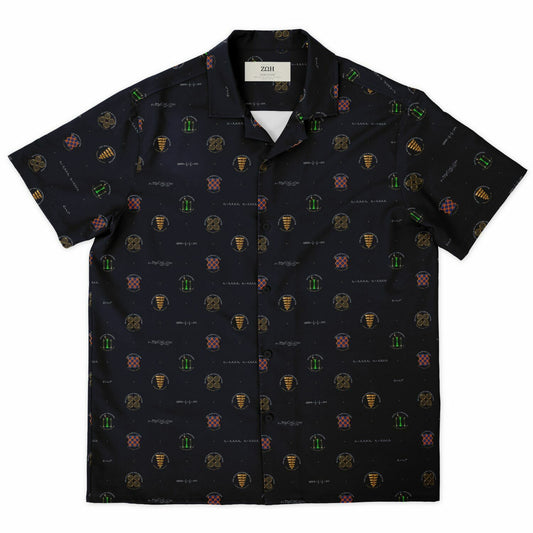
Digital mockup; photos of the finished piece are coming.
Everything Absorbs Button-Up · Paper · Smaller print
Everything Absorbs Button-Up · Paper · Smaller print
Below 100 nm there is no glass and no air: only vacuum, mirrors and a few clever tricks.
Free U.S. shipping on every shirt.
Grand opening: the 10% is already taken off the price shown. Through 30 November.
| Inches | XS | S | M | L | XL | 2XL | 3XL | 4XL |
|---|---|---|---|---|---|---|---|---|
| Chest, flat | 20 | 21 | 22 | 23 | 24½ | 26¾ | 29 | 31¼ |
| Front length | 28½ | 29 | 29½ | 30 | 30¾ | 32 | 33 | 34 |
| Shoulder | 17¾ | 18¼ | 18¾ | 19¼ | 20 | 21⅛ | 22¼ | 23⅜ |
| Sleeve length | 8¼ | 8½ | 8¾ | 9 | 9¼ | 9⅝ | 10 | 10⅜ |
| cm | XS | S | M | L | XL | 2XL | 3XL | 4XL |
|---|---|---|---|---|---|---|---|---|
| Chest, flat | 50.8 | 53.3 | 55.9 | 58.4 | 62.2 | 67.9 | 73.7 | 79.4 |
| Front length | 72.4 | 73.7 | 74.9 | 76.2 | 78.1 | 81.3 | 83.8 | 86.4 |
| Shoulder | 45.1 | 46.4 | 47.6 | 48.9 | 50.8 | 53.7 | 56.5 | 59.4 |
| Sleeve length | 21.0 | 21.6 | 22.2 | 22.9 | 23.5 | 24.4 | 25.4 | 26.4 |
Measured with the shirt laid flat; chest is taken 1 in below the armhole, so double it for the full chest. The easiest check: lay a shirt that fits you flat and compare. Each shirt is cut and sewn by hand, so sizes can vary by up to 1 in. Stretch fabric (12% spandex).
Buying for someone? Compare a shirt they wear with this chart, or choose socks or a tie, which are one size. Or give a gift card and let them choose.
Still unsure? Ask us.
Couldn't load pickup availability
Also from Cutting Edge
-
The tieFormal Logic Medallion Tie · Terminal Green
Regular price $36Sale price $32.40 -
The socksThe Golden Signal Socks · Concept Medallions · Cryostat Blue
Regular price $26Sale price $23.40


The story in the print
The first law of short-wavelength light is that every material absorbs it. Below about 100 nm there is no transparent glass and no air to work in, so the sources must be gases, plasmas or electron beams, and the optics must be multilayer mirrors or diffraction. An intense infrared pulse can pull an electron from an atom and drive it back, and the photon it emits on recombining reaches at most Iₚ + 3.17 Uₚ: the plateau and cutoff of high-harmonic generation, odd harmonics only, each burst a few hundred attoseconds long.
Chips are printed with 13.5 nm light, 91.8 eV a photon, made by heating tin droplets into a plasma and gathered by a molybdenum–silicon multilayer mirror. An undulator, a row of alternating magnets, makes relativistic electrons wiggle and shine at λ = λᵤ(1 + K²/2)/2γ²; the first hard X-ray free-electron laser lased in 2009. And a zone plate focuses X-rays by diffraction, its ring edges at rₙ = √(nλf), every zone the same area and the finest setting the resolution.
On the shirt:
- High-Harmonic Generation: A phosphor screen in a steel flange with nine green lines, harmonics 11 to 27 as a flat-field grating spreads them: plateau, then cutoff.
- Tin-Plasma EUV: Four mirror-bright tin droplets falling toward the focus of a concave collector mirror, one white-violet spark at the focus.
- The Undulator: Sixteen magnet blocks, red and blue, seen from above, and a gold wire for the electron’s path, turning over every block’s center.
- The Zone Plate: A gold Fresnel zone plate of twelve equal-area zones on an amber membrane, set in a polished silicon chip.
This button-up carries EVERYTHING ABSORBS in Paper, printed edge to edge at the smaller print scale. It is made for people who have measured, calibrated and chased the last decimal for a living or for a grade, and for anyone who likes to know what they are wearing.
Details: 88% polyester, 12% spandex stretch fabric, spread collar, short sleeves.
Fabric, care and how it’s made
- Fabric: 88% polyester, 12% spandex
- Fabric weight: 3.83 oz/yd² (130 g/m²)
- Care: machine wash cold, inside out. Do not bleach. Hang to dry. Iron on low.
- Made for adults.
- Made in USA of imported fabric.
- How it’s made: I design every template and check every figure; AI image tools help render the illustrations.
What’s on it The equations, ideas and images on this design, and what they mean
More from Cutting Edge
-
Below Threshold Button-Up · Midnight · Smaller print
Regular price $65Regular price$65Sale price $58.50 -
Sixth Decimal Button-Up · Midnight · Smaller print
Regular price $65Regular price$65Sale price $58.50