Digital mockup; photos of the finished piece are coming.
Full Characterization Button-Up · Engraving
Full Characterization Button-Up · Engraving
Everything a referee asks for before believing what you made.
One colorway: ink on cream.
Free U.S. shipping on every shirt.
Grand opening: the 10% is already taken off the price shown. Through 30 November.
| Inches | XS | S | M | L | XL | 2XL | 3XL | 4XL |
|---|---|---|---|---|---|---|---|---|
| Chest, flat | 20 | 21 | 22 | 23 | 24½ | 26¾ | 29 | 31¼ |
| Front length | 28½ | 29 | 29½ | 30 | 30¾ | 32 | 33 | 34 |
| Shoulder | 17¾ | 18¼ | 18¾ | 19¼ | 20 | 21⅛ | 22¼ | 23⅜ |
| Sleeve length | 8¼ | 8½ | 8¾ | 9 | 9¼ | 9⅝ | 10 | 10⅜ |
| cm | XS | S | M | L | XL | 2XL | 3XL | 4XL |
|---|---|---|---|---|---|---|---|---|
| Chest, flat | 50.8 | 53.3 | 55.9 | 58.4 | 62.2 | 67.9 | 73.7 | 79.4 |
| Front length | 72.4 | 73.7 | 74.9 | 76.2 | 78.1 | 81.3 | 83.8 | 86.4 |
| Shoulder | 45.1 | 46.4 | 47.6 | 48.9 | 50.8 | 53.7 | 56.5 | 59.4 |
| Sleeve length | 21.0 | 21.6 | 22.2 | 22.9 | 23.5 | 24.4 | 25.4 | 26.4 |
Measured with the shirt laid flat; chest is taken 1 in below the armhole, so double it for the full chest. The easiest check: lay a shirt that fits you flat and compare. Each shirt is cut and sewn by hand, so sizes can vary by up to 1 in. Stretch fabric (12% spandex).
Buying for someone? Compare a shirt they wear with this chart, or choose socks or a tie, which are one size. Or give a gift card and let them choose.
Still unsure? Ask us.
Couldn't load pickup availability
Also from Chemistry
-
The tieReaction Time Medallion Tie · Permanganate Potion
Regular price $36Sale price $32.40 -
The socksNoble Company Socks · Concept Medallions · Carbon After Dark
Regular price $26Sale price $23.40


The story in the print
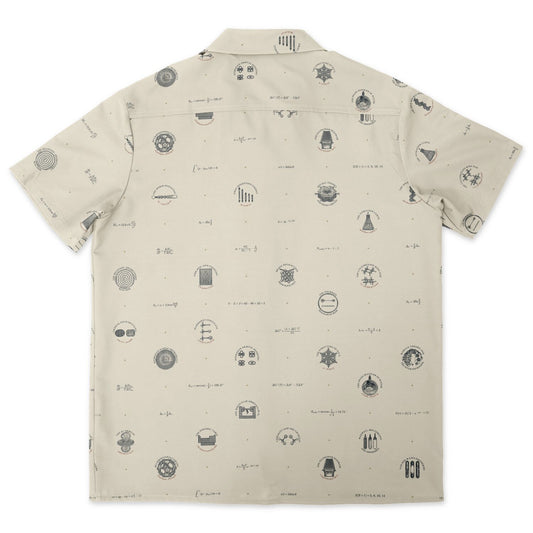
A new compound is not believed until the evidence is in, and each measurement here reads a different property. Color reads the d orbitals. Bethe worked out in 1929 how a metal ion’s neighbors split them: in an octahedron two rise by 3/5 Δo and three fall by 2/5, and a tetrahedron splits them four-ninths as much. Ruby and emerald owe their colors to the same ion, Cr³⁺, in two different crystal fields. Magnetism reads electron pairing. Liquid oxygen hangs between the poles of a magnet because molecular orbital theory puts its last two electrons unpaired, one in each of two π* orbitals: a triplet with bond order two, which no Lewis structure predicts.
X-ray diffraction reads the lattice. The Braggs solved sodium chloride in 1913 and showed that salt contains no molecules at all, each ion sitting among six of the other kind; Lawrence Bragg shared the 1915 Nobel Prize at 25. NMR reads the neighbors. Gutowsky, McCall and Slichter found in 1951 that lines split into multiplets whose spacing does not change with the field, and every chemist reads a quartet beside a triplet as an ethyl group. Vibrational spectroscopy reads the bond itself. Morse’s 1929 potential, built from hydrogen’s constants, says 4.479 eV breaks the bond from its lowest level; the measured value is 4.478.
The five images:
- Crystal Field Splitting: A ruby and an emerald, both colored by Cr³⁺: the same ion in two crystal fields, stronger in ruby and weaker in emerald.
- The Molecular Orbitals of O₂: Pale blue liquid oxygen hanging in the gap of an electromagnet, held there by two unpaired electrons in its π* orbitals.
- Bragg Diffraction from Rock Salt: A 27-ion rock-salt cube, large chloride and small sodium alternating along every row, reflecting a beam at equal angles off its planes.
- NMR Spin–Spin Coupling: A Galton board, one row of pegs for each methyl proton: eight balls fall 1, 3, 3, 1 into four bins, the CH₂ quartet.
- The Morse Potential: A hydrogen molecule as ball and spring, by strobe: thrown back hard from the inner wall, slowing as it stretches far out.
This button-up carries FULL CHARACTERIZATION at full scale. Each image is explained above. It is made for people who have titrated, recrystallized and assigned spectra for a living or for a grade, and for anyone who likes to know what they are wearing.
Details: 88% polyester, 12% spandex stretch fabric, spread collar, short sleeves. Printed and sewn to order.
Fabric, care and how it’s made
- Fabric: 88% polyester, 12% spandex
- Fabric weight: 3.83 oz/yd² (130 g/m²)
- Care: machine wash cold, inside out. Do not bleach. Hang to dry. Iron on low.
- Made for adults.
- Made in USA of imported fabric.
- How it’s made: I design every template and check every figure; AI image tools help render the illustrations.
What’s on it The equations, ideas and images on this design, and what they mean
More from Chemistry
-
Reaction Network Button-Up
Regular price $65Regular price$65Sale price $58.50 -
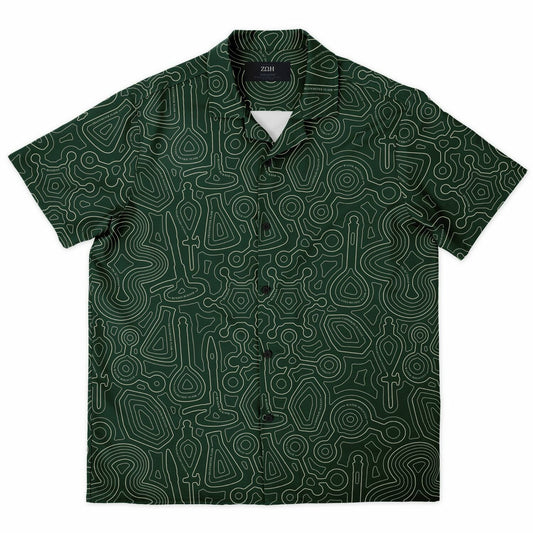
Potential Energy Button-Up · Malachite
Regular price $65Regular price$65Sale price $58.50 -
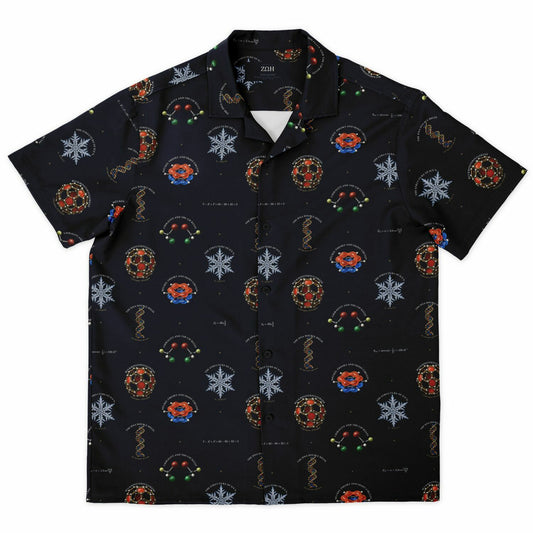
Aufbau Button-Up · Midnight
Regular price $65Regular price$65Sale price $58.50 -
Point Group Button-Up · Midnight
Regular price $65Regular price$65Sale price $58.50