Paleontology · Subject 14

Paleontology

Trilobites, ammonites and a gnat in amber, on button-ups, ties and socks.

Video: National Park Service, White Sands National Park

This week in Paleontology,

A Triassic dinosaur weighed about 400 kg while still young, two teeth reveal a 30 kg Eocene rodent in Thailand, a Peruvian whale had the most lopsided face known, and a North Sea orca hunted big prey over two million years ago.

Get it by email

Download MP3

Behind this page a dinosaur quarry is worked as you scroll: an illustration, not a real specimen. In the badlands of Montana, below the coal seam that marks the K–Pg boundary (66.0 million years), a Triceratops horridus skull in the Hell Creek Formation is brushed out of the rock bone by bone, on a one-meter string grid. Each bone gets a field number and goes on the quarry map; a turtle shell and a crocodylian jaw are labeled not a dinosaur. The skull is pedestaled, jacketed in plaster and burlap (about 2.0 metric tons, a model), rolled over and lifted out, and the finished map stays.

Welcome in

For anyone who has jacketed a bone

You know the field season: prospecting an eroding slope with your eyes on the ground, then the plaster and hessian, and the jacket that has to come home in one piece. You know the months at the prep bench with an air scribe and a needle, one grain at a time. You have split shale all afternoon for one good trilobite, and you can finish Playfair’s sentence about the abyss of time.

Start with everything

THE FOSSIL RECORD, Bone
THE FOSSIL RECORDRegular price $65 Sale price $58.50Shop now

Colorway
Bone

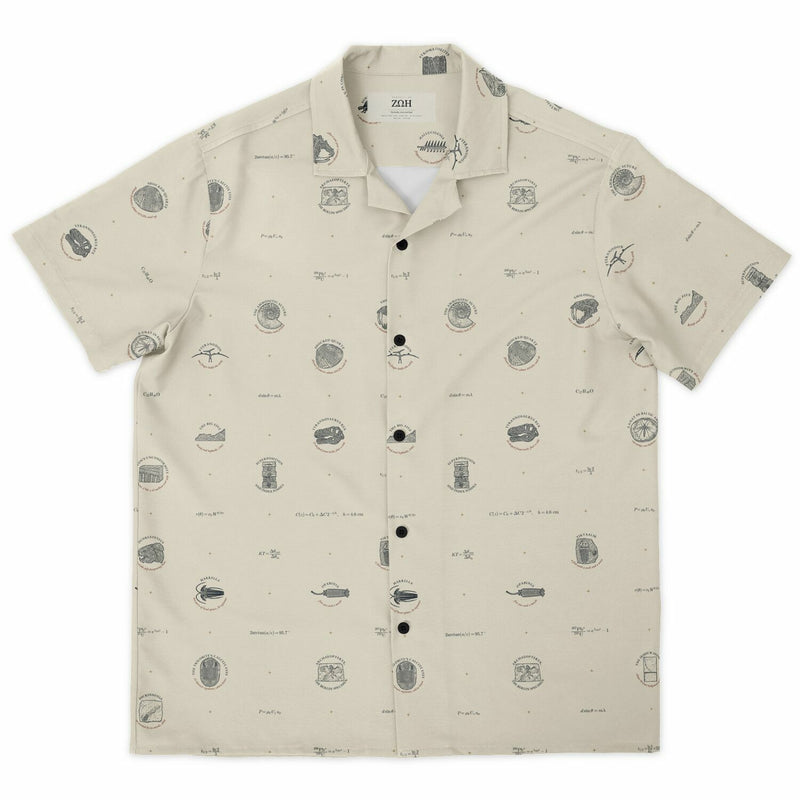
Whole-field medallions · repeats every 18 in

Short-sleeve button-up · XS–4XL

THE FOSSIL RECORD

The whole field, on one shirt.

Paleontology brought together in one design, printed edge to edge: 25 medallions from the field’s designs, with the equations from across the subject. Related images are spread across the pattern so no two neighbors repeat.

  • Print scaleThe pattern repeats every 18 inches, with seamless edges.
  • StylesPhotoreal on bone, engraving or blueprint.
Shop now · Regular price $65 Sale price $58.50

Leave your email and we’ll write the day it’s ready.

STRATA SOCIETY, Baize
STRATA SOCIETYRegular price $65 Sale price $58.50Shop now

Colorway

Contour map · repeats every 18 in

Short-sleeve button-up · XS–4XL

STRATA SOCIETY

A topographic portrait of the field.

Recognizable forms from Paleontology rise as contour landscapes. Lines follow the outlines and continue across the ground between them, with names fitted along the contours.

  • Print scaleThe pattern repeats every 18 inches, with seamless edges.
  • The paletteTwo colorways, shown at the same print scale.
Shop now · Regular price $65 Sale price $58.50

Leave your email and we’ll write the day it’s ready.

Socks mix and match across every field: three pairs for $69, and two ship free in the U.S.

Crew socks · One size

Crew socks

A field of your own, from cuff to toe.

  • The pattern
  • The previewA studio mockup; photos of the finished pair are on the way.
Shop now · Regular price $26 Sale price $23.40

Leave your email and we’ll write the day this pair is ready.

Necktie · 3.5 in wide

Subject ties

A formal introduction to your field.

  • The color
  • The previewStudio render of the tie. Zoom shows the print up close.
Shop now · Regular price $36 Sale price $32.40

Leave your email and we’ll write the day this tie is ready.

More designs to explore

Short-sleeve button-up · XS–4XL

DEAD CLADE WALKING

Five mass extinctions, the evidence they left, and who walked away.

Dead clade walking is David Jablonski’s phrase, from 2002, for groups that survive a mass extinction only to fade afterwards. In 1982 David Raup and Jack Sepkoski counted marine animal families stage by stage and picked out five extinctions above the background: the end-Ordovician, Late Devonian, end-Permian, end-Triassic and end-Cretaceous, at 443, 372, 252, 201 and 66 million years ago on the International Commission on Stratigraphy’s chart, version 2024/12. The end-Permian was the worst by far, with estimates of species lost in the sea running from about 81 to 96 percent. In its aftermath Lystrosaurus, a tusked, beaked plant-eater, spread across southern Pangaea, and its fossils in Antarctica, found in 1969, helped show that the southern continents had once been joined.

The end of the Cretaceous left its evidence in a centimeter of clay. Walter Alvarez wanted to know how long the clay at Gubbio had taken to settle, and his father Luis suggested measuring iridium; with Frank Asaro and Helen Michel they found about thirty times the background, and in 1980 put the impactor at 10 ± 4 km across. In 1984 Bruce Bohor and colleagues found quartz grains in the boundary clay crossed by straight lamellae that no volcano makes, and in 1991 the Chicxulub crater, about 180 km across, was identified beneath the Yucatán. The idea of extinction began with teeth: in 1796 Georges Cuvier showed that the mammoth and the Ohio animal differed from both living elephants, and were gone.

  • LystrosaurusA Lystrosaurus skull from the Karoo: a short, deep head bent down into a beak, and two tusks, its only teeth.
  • Shocked QuartzOne shocked quartz grain from the boundary clay under crossed polarizers, ruled by two straight sets of lamellae and a faint third.
  • The Iridium AnomalyA polished slab through the boundary at Gubbio, a gold line inlaid as the iridium graph: flat, a spike at the clay, a long tail.
  • The Big FiveA fossil-packed limestone relief whose skyline is Sepkoski’s diversity curve, cut by five notches, the end-Permian by far the deepest.
  • Mammoth and MastodonA woolly mammoth molar ridged with more than twenty enamel plates beside a mastodon molar studded with paired cusps.
Shop now · Regular price $65 Sale price $58.50

Leave your email and we’ll write the day it’s ready.

Short-sleeve button-up · XS–4XL

TAPHONOMY

Five fossils everyone knows, each kept by a different trick of burial.

Taphonomy is the study of how a living thing becomes a fossil, and each of these five famous specimens took a different road. The trilobite kept its own calcite, down to the lenses of its eyes. Each lens was a single crystal grown with its optical axis perpendicular to the surface, so light arriving head-on is not doubled by calcite’s double refraction, and in 1975 Euan Clarkson and Riccardo Levi-Setti showed that some are doublets whose inner surface follows the curves Descartes and Huygens worked out to remove spherical aberration. The ammonite’s shell dissolved, and the stone that filled its chambers shows the sutures: plain zigzags in the Paleozoic, frilled like ferns in the Jurassic and Cretaceous.

Archaeopteryx sank into the fine lime mud of a Jurassic lagoon at Solnhofen, feathers and all. The Berlin specimen, found in 1874 or 1875, was the first with a complete head, and Werner von Siemens paid 20,000 gold marks for it in 1880 so that Berlin could keep it. Barnum Brown dug the first Tyrannosaurus rex out of the Hell Creek Formation of Montana in 1902, its bones permineralized in the ground, and Henry Fairfield Osborn named it in 1905. The gnat was swallowed whole by the resin of an Eocene forest. Amber keeps bristles and wing veins, but not DNA, which breaks so fast that a 242-base stretch has a half-life of 521 years.

  • The Trilobite’s Calcite EyesEldredgeops rana on gray Devonian shale: three lobes, eleven thoracic segments, and kidney-shaped eyes of separate calcite lenses in vertical files.
  • The Ammonitic SutureAn ammonite’s polished internal mold, its sutures frilled like fern leaves and nesting along the coil, the body chamber left smooth.
  • A Gnat in Baltic AmberA fungus gnat in backlit Baltic amber: two wings, two halteres, star-shaped oak hairs, and a milky veil on one side.
  • Archaeopteryx, the Berlin SpecimenThe Berlin Archaeopteryx in pale Solnhofen limestone: head thrown back, teeth, three clawed fingers a hand and a long feathered bony tail.
  • Tyrannosaurus rexA Tyrannosaurus rex skull in side view: nostril, antorbital fenestra, keyhole eye socket, and four small D-shaped teeth at the front.
Shop now · Regular price $65 Sale price $58.50

Leave your email and we’ll write the day it’s ready.

Short-sleeve button-up · XS–4XL

NOT A DINOSAUR

Fish, fishapod, synapsid, pterosaur and cat: everyone calls them dinosaurs.

Paleontologists say it so often that it has become a joke: that is not a dinosaur. Dunkleosteus was an armored fish of the Late Devonian seas, known from the Cleveland Shale of Ohio almost entirely by its head and shoulder armor, and it had no teeth: its jaws were bony plates worn against each other into self-sharpening blades. In 2023 Russell Engelman cut the old length estimates of five to ten meters to about 3.4 for a typical adult. Tiktaalik was a fish with a neck. Neil Shubin, Edward Daeschler and Farish Jenkins chose Late Devonian stream deposits on Ellesmere Island for their age, found it in 2004 and published it in 2006: scales, gills and fins, but a flat head with eyes on top and a fin with a wrist.

Dimetrodon turns up in nearly every box of toy dinosaurs, yet it died out some forty million years before the first dinosaur appeared. It is a synapsid, with a single opening in the skull behind the eye, the lineage that later produced mammals, so it is closer to us than to any dinosaur. Pteranodon, named by Othniel Charles Marsh in 1876 from the Niobrara Chalk of Kansas, is a pterosaur, from a separate branch of reptiles that flew on one enormously long fourth finger. And Smilodon fatalis, the saber-toothed cat of the Rancho La Brea asphalt seeps in Los Angeles, is a machairodont, from an extinct branch of the cat family that split off long before tigers appeared.

  • DunkleosteusThe armored head and shoulder shield of Dunkleosteus, jaws open: no teeth, only bony blades rising to fang-like points.
  • TiktaalikTiktaalik in red Devonian siltstone: a flat head with eyes on top, a neck, and a fin with an upper arm and a wrist.
  • SmilodonA tar-stained Smilodon skull from La Brea, jaw dropped wide: two long serrated sabers above, small lower canines below.
  • DimetrodonDimetrodon’s skeleton in side view: a sail of long spines, sprawling limbs, teeth of two sizes and one opening behind the eye.
  • PteranodonPteranodon from above, wings spread: each wing hung from one immensely long fourth finger, three small clawed fingers in front, no teeth.
Shop now · Regular price $65 Sale price $58.50

Leave your email and we’ll write the day it’s ready.

Short-sleeve button-up · XS–4XL

STEM GROUP

Gould’s weird wonders and an older puzzle, each placed on the tree of life by 2018.

A stem group is made of the extinct relatives of a living group that split away before its living members’ last common ancestor, and the Burgess Shale is full of them. Charles Walcott found its first fossils in 1909 and opened the quarry in 1910, and Stephen Jay Gould called its strangest animals weird wonders; most are stem members of living groups. Radiodonts were found in pieces. Joseph Whiteaves described the spiny appendage of Anomalocaris in 1892 as the body of a shrimp, and in 1911 Walcott named a radiodont’s plated mouth as a jellyfish and its body as a sea cucumber, until Harry Whittington’s preparation in the early 1980s showed that such parts belonged to large swimming predators.

Opabinia has five eyes and a hose-like nozzle ending in a claw, and when Whittington showed an early reconstruction to a meeting in 1972, the room burst out laughing. Hallucigenia was reconstructed in 1977 walking on its spines, turned over in 1991, and given its head, at the other end, in 2015. Marrella, the commonest animal in the quarry, flashed iridescent color from diffraction gratings on its surface. Dickinsonia, some fifty million years older, is the odd one out: a quilted oval with no head, mouth or gut, shown to be an animal in 2018 by the animal sterols in its thin organic film.

  • DickinsoniaDickinsonia on the underside of an Ediacaran sandstone bed, a quilted oval trailed by three fading prints where it stopped to feed.
  • MarrellaMarrella from above: two pairs of iridescent head spines sweeping back over a lacy body of twenty-six feathery segments.
  • AnomalocarisAnomalocaris from above: two spiny grasping appendages, stalked eyes, sixteen pairs of swimming flaps and a fan of tail blades.
  • OpabiniaOpabinia from above: five eyes on the head, a ringed nozzle ending in a spiny claw, fifteen pairs of gill-bearing flaps.
  • HallucigeniaHallucigenia the right way up: seven pairs of spines on its back, seven pairs of clawed legs, and a small head on a long neck.
Shop now · Regular price $65 Sale price $58.50

Leave your email and we’ll write the day it’s ready.

Short-sleeve button-up · XS–4XL

NO VESTIGE

Reading deep time, from a Scottish shoreline to a single zircon.

In 1788 James Hutton took John Playfair and Sir James Hall by boat to Siccar Point on the Berwickshire coast, where gray Silurian graywackes stand on end, worn flat and buried under gently dipping Old Red Sandstone. Hutton read the contact as a sequence of sea floor, uplift, erosion and burial again, each at the slow rates he could watch in his own day; the gap is about 65 million years. Playfair wrote that the mind seemed to grow giddy by looking so far into the abyss of time, and Hutton’s Theory of the Earth ends with the line this design is named for: no vestige of a beginning, no prospect of an end.

Geologists have since put numbers on it. Nicolaus Steno set out superposition in 1669, and William Smith, a canal surveyor, found that each layer carries its own fossils in a fixed order and used them for his geological map of England and Wales in 1815. Stromatolites, built by microbial mats, include probable ones 3.48 billion years old in the Pilbara, and their upward-bulging layers show which way up a folded bed was laid down. And a single zircon carries two uranium clocks, with half-lives of 4.468 and 0.704 billion years; George Wetherill’s concordia of 1956 checks one against the other.

  • Superposition and Index FossilsA pillar of five rocks, each with its index fossil: trilobite, graptolites, goniatite, ammonite and belemnite, oldest at the bottom.
  • Zircon, the TimekeeperA zircon in cathodoluminescence: fine growth bands parallel to its faces, an older rounded core, and two laser pits.
  • StromatolitesA polished stromatolite slab: hundreds of fine laminae arched upward in columns, one splitting in two as it grows.
  • Hutton’s UnconformityA block model of Siccar Point: near-vertical gray beds planed flat, a thin pebble layer, then gently tilted red sandstone.
  • The U-Pb ConcordiaThe concordia as a bent gold rod, beads every 500 million years, crossed by a glass discordia threaded with tilted ellipses.
Shop now · Regular price $65 Sale price $58.50

Leave your email and we’ll write the day it’s ready.

Short-sleeve button-up · XS–4XL

EQUATION STRIPE

From Huxley’s allometry to the molecular clock, every line labeled.

Deep time is read with measurements: ages, rates, sizes, temperatures. The Equation Stripe sets forty-five of the field’s equations in rows, each introduced by its name in capitals, so U–PB CONCORDIA, HUXLEY ALLOMETRY and VAN VALEN’S LAW read at a glance. Together they make a working paleontologist’s toolkit: how old a rock is, how big an animal was and how fast it moved, how sediment buries a body and keeps it, what isotopes say about ancient climate, and how lineages arise and die out.
Eleven rows carry the science of the collection’s five picture designs, from the concordia and the Jack Hills zircon to the iridium anomaly and the trilobite’s Cartesian oval; the other fourteen objects, from Hutton’s unconformity to the tyrannosaur’s skull, are read from rock and bone rather than from an equation. The remaining thirty-four rows are the field’s workhorses: radiocarbon ages, the Shields parameter, Milankovitch periods, clumped isotopes, the molecular clock and Jukes–Cantor distances among them.

  • Huxley Allometryy = axb ⇔ log y = log a + b log x
  • Body Mass From BonesM = 0.078Ch+f2.73 (g, mm)
  • EncephalizationEQ = E/(0.12P2/3)
  • Trackway Speedv = 0.25g0.5λ1.67h−1.17
  • Raup Shell Coilingr(θ) = r0Wθ/(2π)
  • Kinematic TransmissionKT = Δθout/Δθin
Shop now · Regular price $65 Sale price $58.50

Leave your email and we’ll write the day it’s ready.

Short-sleeve button-up · XS–4XL

CONCEPT STRIPE

From Steno’s layers to the K–Pg boundary, deep time in short lines.

The Concept Stripe carries paleontology’s working knowledge: how to read the rocks, how fossils form, the landmarks of the record, extinction and evolution, and the methods, each after a short heading in capitals. About every fourth unit is an equation from the Equation Stripe, so HUXLEY ALLOMETRY and the AGE EQUATION turn up between the Burgess Shale and the Big Five.

  • SUPERPOSITIONyounger layers lie on older ones
  • TAPHONOMYhow a dead organism becomes a fossil
  • BURGESS SHALEWalcott, 1909: soft-bodied Cambrian life
  • BIG FIVEthe five great mass extinctions
  • HALF-LIFEthe time for half the parent atoms to decay
  • FAUNAL SUCCESSIONWilliam Smith: each layer its own fossils
Shop now · Regular price $65 Sale price $58.50

Leave your email and we’ll write the day it’s ready.

HUXLEY ALLOMETRYy = axb ⇔ log y = log a + b log x·BODY MASS FROM BONESM = 0.078Ch+f2.73 (g, mm)·ENCEPHALIZATIONEQ = E/(0.12P2/3)·TRACKWAY SPEEDv = 0.25g0.5λ1.67h−1.17·RAUP SHELL COILINGr(θ) = r0Wθ/(2π)·KINEMATIC TRANSMISSIONKT = Δθout/Δθin·RATE IN DARWINSr = (ln x2 − ln x1)/Δt·RADIOACTIVE DECAYN(t) = N0e−λt·AGE EQUATIONt = (1/λ)ln(1 + D*/P)·RB–SR ISOCHRON87Sr/86Sr = (87Sr/86Sr)0 + (87Rb/86Sr)(eλt − 1)·POTASSIUM–ARGONt = (1/λ)ln[1 + (λ/λe)(40Ar*/40K)]·ARGON–ARGONt = (1/λ)ln[1 + J(40Ar*/39ArK)]·U–PB CONCORDIA206Pb*/238U = exp(λ238t) − 1, 207Pb*/235U = exp(λ235t) − 1·JACK HILLS ZIRCON206Pb*/238U = exp(λ238t) − 1 = 0.980 (t = 4.404 Gyr)·PB–PB ISOCHRON(207Pb/206Pb)* = (exp(λ235t) − 1)/(137.88(exp(λ238t) − 1))·AGE OF THE EARTHt⊕ = 4.54 ± 0.05 Gyr·RADIOCARBON AGEt = −8033 ln(F14C)·LUMINESCENCE AGEt = De/Ḋ·RACEMIZATION DATINGln[(1 + D/L)/(1 − D/L)] = 2kt + const·SHIELDS PARAMETERθ = τb/((ρs − ρ)gD)·ATHY COMPACTIONφ(z) = φ0e−cz·MASS ACCUMULATION RATEMAR = LSR×ρdry·MILANKOVITCH PERIODSPe = 405, 100 kyr; Pε = 41 kyr; Pϖ = 23, 19 kyr·POISSON PRESERVATIONPpres = 1 − e−ψΔt·HUXLEY ALLOMETRYy = axb ⇔ log y = log a + b log x·BODY MASS FROM BONESM = 0.078Ch+f2.73 (g, mm)·ENCEPHALIZATIONEQ = E/(0.12P2/3)·TRACKWAY SPEEDv = 0.25g0.5λ1.67h−1.17·RAUP SHELL COILINGr(θ) = r0Wθ/(2π)·KINEMATIC TRANSMISSIONKT = Δθout/Δθin·RATE IN DARWINSr = (ln x2 − ln x1)/Δt·RADIOACTIVE DECAYN(t) = N0e−λt·AGE EQUATIONt = (1/λ)ln(1 + D*/P)·RB–SR ISOCHRON87Sr/86Sr = (87Sr/86Sr)0 + (87Rb/86Sr)(eλt − 1)·POTASSIUM–ARGONt = (1/λ)ln[1 + (λ/λe)(40Ar*/40K)]·ARGON–ARGONt = (1/λ)ln[1 + J(40Ar*/39ArK)]·U–PB CONCORDIA206Pb*/238U = exp(λ238t) − 1, 207Pb*/235U = exp(λ235t) − 1·JACK HILLS ZIRCON206Pb*/238U = exp(λ238t) − 1 = 0.980 (t = 4.404 Gyr)·PB–PB ISOCHRON(207Pb/206Pb)* = (exp(λ235t) − 1)/(137.88(exp(λ238t) − 1))·AGE OF THE EARTHt⊕ = 4.54 ± 0.05 Gyr·RADIOCARBON AGEt = −8033 ln(F14C)·LUMINESCENCE AGEt = De/Ḋ·RACEMIZATION DATINGln[(1 + D/L)/(1 − D/L)] = 2kt + const·SHIELDS PARAMETERθ = τb/((ρs − ρ)gD)·ATHY COMPACTIONφ(z) = φ0e−cz·MASS ACCUMULATION RATEMAR = LSR×ρdry·MILANKOVITCH PERIODSPe = 405, 100 kyr; Pε = 41 kyr; Pϖ = 23, 19 kyr·POISSON PRESERVATIONPpres = 1 − e−ψΔt·

The science on the shirt

What you’re wearing

Every object on the shirts, and the science behind it.

The Trilobite’s Calcite Eyes

TAPHONOMY

The Trilobite’s Calcite Eyes

11 thoracic segments, calcite lenses

Trilobites looked out through calcite. Each lens of a phacopid eye was a single crystal set with its optical axis perpendicular to the surface, so head-on light is not doubled. In 1975 Clarkson and Levi-Setti found doublet lenses that correct spherical aberration, and Niles Eldredge’s counts of lens files in this species helped found punctuated equilibrium.

The Ammonitic Suture

TAPHONOMY

The Ammonitic Suture

lobes and saddles both frilled

Where each septum met the shell it left a suture, visible only once the shell is gone. Sutures sort the ammonoids: plain zigzags in Devonian to Permian goniatites, serrated lobes in Triassic ceratites, fern-like frills in the ammonites of the Jurassic and Cretaceous. Why they grew so elaborate is still argued.

A Gnat in Baltic Amber

TAPHONOMY

A Gnat in Baltic Amber

two wings, two halteres

Baltic amber is the resin of Eocene forests, marked by star-shaped oak hairs and a milky film on one side of many insects. It keeps bristles and wing veins, but not DNA: a 242-base stretch has a half-life of 521 years. This insect has two wings and two halteres, so it is a fly, a fungus gnat.

Archaeopteryx, the Berlin Specimen

TAPHONOMY

Archaeopteryx, the Berlin Specimen

teeth, three claws, a bony tail

Two years after the Origin of Species, the Solnhofen quarries yielded a feather, then a skeleton with feathered wings, teeth, clawed fingers and a long bony tail. The Berlin specimen, found in 1874 or 1875, was the first with a complete head. Like almost every articulated Archaeopteryx, it lies in the death pose, head thrown back.

Tyrannosaurus rex

TAPHONOMY

Tyrannosaurus rex

D-shaped front teeth, four a side

Barnum Brown dug the first Tyrannosaurus rex from the Hell Creek Formation of Montana in 1902, and Osborn named it in 1905. Its skull is a row of archosaur landmarks: nostril, antorbital fenestra, keyhole-shaped eye socket, lower temporal opening. The four small front teeth on each side of the upper jaw are D-shaped in section, a tyrannosaurid signature.

Dunkleosteus

NOT A DINOSAUR

Dunkleosteus

no teeth: self-sharpening bone

Dunkleosteus had no teeth. Its jaws were bony plates worn against each other into self-sharpening blades, rising at the front into fang-like points. In 2007 Anderson and Westneat modeled the skull as a four-bar linkage and found jaws that opened fast and bit hard. A typical adult was about 3.4 meters long, not the old five to ten.

Tiktaalik

NOT A DINOSAUR

Tiktaalik

a fish with a neck and a wrist

Shubin, Daeschler and Jenkins picked Ellesmere Island because its rocks, Late Devonian stream deposits about 375 million years old, were the right age to hold something between fish and the first four-legged animals. They found Tiktaalik in 2004: gills, scales and fin rays, but a flat head, a neck, and a fin with a wrist.

Smilodon

NOT A DINOSAUR

Smilodon

not a dinosaur, and not a tiger

The saber-toothed cat of the Rancho La Brea asphalt seeps is neither a tiger nor a dinosaur. It is a machairodont, from an extinct branch of the cat family, with flattened, finely serrated upper canines and a jaw that dropped far wider than a lion’s. The asphalt stained its bones brown-black. It is California’s state fossil.

Dimetrodon

NOT A DINOSAUR

Dimetrodon

a synapsid: our side of the tree

Dimetrodon is in nearly every box of toy dinosaurs, but it lived in the Early Permian and died out some forty million years before the first dinosaur. It is a synapsid, with one opening in the skull behind the eye, on the line that led to mammals. Cope named it in 1878 for its two measures of teeth.

Pteranodon

NOT A DINOSAUR

Pteranodon

one finger holds the wing

Marsh named it in 1876 from the Niobrara Chalk of Kansas: wing without tooth. Pterosaurs were the first vertebrates to fly under their own power, and they are not dinosaurs. The wing gives them away: a bat uses four fingers, a bird a fused hand, but a pterosaur hung its whole outer wing from one long fourth finger.

Dickinsonia

STEM GROUP

Dickinsonia

an animal by its sterols, 2018

Dickinsonia lived about 558 million years ago, before the Cambrian, and for decades nobody could agree what it was. In 2018 Ilya Bobrovskiy and colleagues extracted molecules from its thin organic film and found almost nothing but cholesteroids, the sterols of animals. Chains of faint impressions show that it rested, apparently fed on the microbial mat, then moved on.

Marrella

STEM GROUP

Marrella

two pairs of head spines, 26 segments

Marrella splendens is the commonest animal in Walcott’s quarry of the Burgess Shale: Walcott found it in 1909. Harry Whittington showed in 1971 that it was neither trilobite nor crustacean. In 1998 Andrew Parker reported diffraction gratings on its surface, so in life its spines would have flashed iridescent color.

Anomalocaris

STEM GROUP

Anomalocaris

its claw was first named as a shrimp

Its kind was named three times before anyone saw a whole one: a spiny appendage described as a shrimp in 1892, and in 1911 a round, plated mouth named as a jellyfish and a body as a sea cucumber. Harry Whittington’s work in the early 1980s showed such parts belonged to large swimming predators, the radiodonts.

Opabinia

STEM GROUP

Opabinia

five eyes and a nozzle

When Harry Whittington showed an early reconstruction to a meeting of paleontologists in 1972, the room burst out laughing. Opabinia has five eyes, a flexible nozzle about four times the head’s length ending in a spiny claw, and fifteen segments with gill-bearing flaps. Graham Budd placed it on the arthropod stem in 1996, near the radiodonts.

Hallucigenia

STEM GROUP

Hallucigenia

flipped in 1991, head found in 2015

Simon Conway Morris named it in 1977 for its dreamlike look and stood it on seven pairs of spines. In 1991 Lars Ramsköld and Hou Xianguang turned it over: the spines were on its back and the tentacles were legs. In 2015 Martin Smith and Jean-Bernard Caron found its head, at the other end.

Lystrosaurus

DEAD CLADE WALKING

Lystrosaurus

two tusks, no other teeth

Lystrosaurus, the shovel lizard, was a pig-sized, beaked plant-eater with only two teeth, a pair of tusks. It crossed the end-Permian extinction and flooded the emptied world: in the earliest Triassic of the Karoo it makes up most of the vertebrate fossils. Found in Antarctica in 1969, it helped show the southern continents were once joined.

Shocked Quartz

DEAD CLADE WALKING

Shocked Quartz

planar features: about 10 GPa and up

A shock from an impact leaves a signature no volcano can: thin, dead-straight lamellae across a quartz grain, in several sets, formed from about 10 GPa. In 1984 Bruce Bohor and colleagues found such grains in the boundary clay in Montana. With the iridium they pointed to an impact, and Chicxulub, about 180 km across, was identified in 1991.

The Iridium Anomaly

DEAD CLADE WALKING

The Iridium Anomaly

about 30 times background at Gubbio

Walter Alvarez wanted to know how long the centimeter of clay at Gubbio had taken to settle, and his father Luis suggested measuring iridium. With Frank Asaro and Helen Michel they found 0.3 parts per billion below it and 9.1 in its red upper half, more than thirty times higher. Above it, the excess halves every 4.6 cm.

The Big Five

DEAD CLADE WALKING

The Big Five

Raup and Sepkoski, 1982

In 1982 David Raup and Jack Sepkoski picked out five extinctions above the background in the marine fossil record. On the International Commission on Stratigraphy’s chart, version 2024/12, they fall 18, 31, 53, 63 and 88 percent of the way along the Phanerozoic, where the notches are cut. The end-Permian is the worst by far. The relief is a schematic of Sepkoski’s curve.

Mammoth and Mastodon

DEAD CLADE WALKING

Mammoth and Mastodon

Cuvier, 1796: extinction is real

In 1796 Georges Cuvier showed that the mammoth of Siberia and the Ohio animal differed from both living elephants. Animals that large could hardly be hiding, so they were gone: extinction was real. The teeth tell it at a glance: a mammoth’s grinding mill of thin enamel plates for grass, a mastodon’s paired cusps for browsing.

Superposition and Index Fossils

NO VESTIGE

Superposition and Index Fossils

oldest at the bottom: Steno, 1669

Nicolaus Steno set out the rule in 1669: in undisturbed layers the lowest is the oldest. William Smith, a canal surveyor, found that each layer also carries its own fossils in a fixed order. The best index fossils lived briefly, spread widely and are easy to tell apart, and they still do most day-to-day correlation.

Zircon, the Timekeeper

NO VESTIGE

Zircon, the Timekeeper

Jack Hills, 2001: 4.404 Ga

Zircon takes uranium into its lattice as it grows and all but excludes lead, so its clock starts near zero, and its closure temperature for lead is above 900 °C. In 2001 a Jack Hills zircon dated at 4.404 billion years became the oldest known piece of the Earth: 0.98 atoms of lead-206 for every atom of uranium-238 left.

Stromatolites

NO VESTIGE

Stromatolites

convex side up: the way-up test

A stromatolite is a rock built by microbes: mats trap sediment and help carbonate precipitate, each new mat over the last. Probable stromatolites in the Pilbara are 3.48 billion years old. Their laminae bulge upward, so a mapper who finds them upside down knows the beds are overturned.

Hutton’s Unconformity

NO VESTIGE

Hutton’s Unconformity

Siccar Point, 1788: a 65-million-year gap

In 1788 James Hutton took Playfair and Hall by boat to Siccar Point, where Silurian graywackes stand on end, worn flat and buried under Old Red Sandstone. He read the contact as sea floor, uplift, erosion and burial again, at the slow rates of his own day. The gap is about 65 million years.

The U-Pb Concordia

NO VESTIGE

The U-Pb Concordia

half-lives 4.468 and 0.704 billion years

Uranium carries two clocks: uranium-238 decays to lead-206 with a half-life of 4.468 billion years, uranium-235 to lead-207 with 0.704. Plot one ratio against the other and every undisturbed crystal falls on Wetherill’s 1956 concordia. A crystal that lost lead slides off along a chord whose ends give both its age and the disturbance.