Marine Biology · Subject 13

Marine Biology

Button-ups, ties and socks from the coral reef down to the black smoker.

This week in Marine Biology,

Repeat bleaching remakes the Great Barrier Reef’s coral mix, a kelp turns to cloning only when mates are absent, sea pigs host a pared-down skin microbe, and twilight-zone fish and shrimp show thin gene pools.

Get it by email

Download MP3

Behind this page a CTD rosette descends as you scroll, from the sea surface to 10 m above the floor of the Challenger Deep, 10,935 m down. The page takes the color of the daylight that reaches each depth, computed from the absorption of pure water (Pope and Fry 1997) with a small allowance for plankton and dissolved matter (model): 1 % of the red is left at 13.5 m, 1 % of the blue at 196 m, and below about 1,000 m the sun is gone. A CTD trace draws itself beside the wire from a model profile of the tropical western Pacific: temperature, salinity, oxygen, chlorophyll and sound speed (Mackenzie 1981). Sound is slowest, 1,485.7 m/s, at 1,018 m, the SOFAR axis. Water’s saturation pressure at 350 °C, 16.53 MPa, is reached at 1,640 m, so 350 °C vent water deeper than that stays liquid. The in-situ temperature is lowest, 1.59 °C, at 4,912 m; below it compression warms the water, to 2.48 °C at the floor, where the potential temperature is 1.02 °C. The pressure at the floor is 1,126.6 bar, 3.0 % more than one bar per ten meters. Marine snow thins with depth along the Martin curve. Fish of species documented at each depth swim at their own depths: yellowfin tuna, mahi-mahi, oceanic whitetip sharks and flyingfish near the surface under a Portuguese man o’ war, a humpback anglerfish, Warming’s lanternfish at its daytime depth, a pelican eel, an abyssal grenadier and the Mariana snailfish; none below about 8,200 m, where fish are predicted to reach their osmotic limit; on the floor, the amphipod Hirondellea gigas. Moving the pointer through the water releases air bubbles whose size follows the pressure at the rosette’s depth.

Welcome in

For anyone who has fired a Niskin

You know the CTD watch at three in the morning, the rosette rising out of black water, and the bottles closed on the way up, deepest first. You have watched the scattering layer climb the echo sounder at dusk, right on time, and sorted a trawl on a deck that would not keep still. You have explained on a beach that the thing that stung someone is not a jellyfish, and at a party that the nautilus is not a golden spiral.

Start with everything

THE LIVING OCEAN, Bone
THE LIVING OCEANRegular price $65 Sale price $58.50Shop now

Colorway
Bone

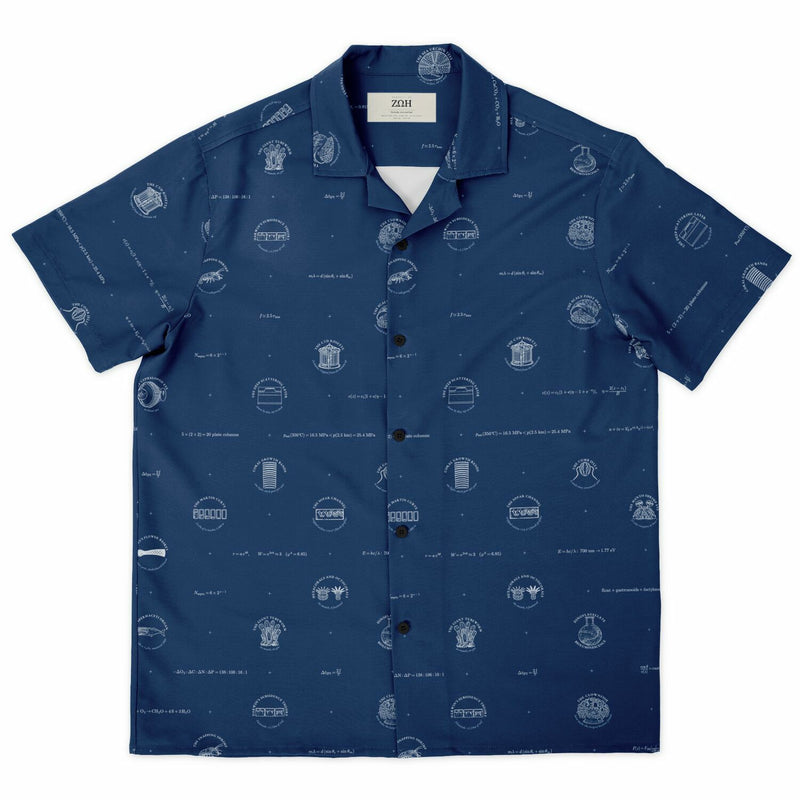
Whole-field medallions · repeats every 18 in

Short-sleeve button-up · XS–4XL

THE LIVING OCEAN

The whole field, on one shirt.

Marine Biology brought together in one design, printed edge to edge: 25 medallions from the field’s designs, with the equations from across the subject. Related images are spread across the pattern so no two neighbors repeat.

  • Print scaleThe pattern repeats every 18 inches, with seamless edges.
  • StylesPhotoreal on bone, engraving or blueprint.
Shop now · Regular price $65 Sale price $58.50

Leave your email and we’ll write the day it’s ready.

BELOW THE SURFACE, Foam
BELOW THE SURFACERegular price $65 Sale price $58.50Shop now

Colorway

Contour map · repeats every 18 in

Short-sleeve button-up · XS–4XL

BELOW THE SURFACE

A topographic portrait of the field.

Recognizable forms from Marine Biology rise as contour landscapes. Lines follow the outlines and continue across the ground between them, with names fitted along the contours.

  • Print scaleThe pattern repeats every 18 inches, with seamless edges.
  • The paletteTwo colorways, shown at the same print scale.
Shop now · Regular price $65 Sale price $58.50

Leave your email and we’ll write the day it’s ready.

Socks mix and match across every field: three pairs for $69, and two ship free in the U.S.

Crew socks · One size

Crew socks

A field of your own, from cuff to toe.

  • The pattern
  • The previewA studio mockup; photos of the finished pair are on the way.
Shop now · Regular price $26 Sale price $23.40

Leave your email and we’ll write the day this pair is ready.

Necktie · 3.5 in wide

Subject ties

A formal introduction to your field.

  • The color
  • The previewStudio render of the tie. Zoom shows the print up close.
Shop now · Regular price $36 Sale price $32.40

Leave your email and we’ll write the day this tie is ready.

More designs to explore

Short-sleeve button-up · XS–4XL

DARWIN’S PARADOX

Rainforest richness in water as clear and poor as a desert: how a coral reef pays its way.

Coral reefs are among the richest ecosystems on Earth, yet they grow in water nearly empty of nutrients: Darwin’s paradox. Part of the answer lives inside the polyps. Reef-building corals are hexacorals, their tentacles and septa in multiples of six, and their golden-brown color is symbiotic dinoflagellates living in their cells; octocorals, the soft corals and sea fans, always have eight feathered tentacles. Darwin had already solved another reef puzzle. Before he had seen a reef, he reasoned in 1835 that a reef around a sinking island keeps building up toward the light, from fringing reef to barrier reef to atoll, and in 1951 and 1952 drilling at Enewetak struck volcanic basalt beneath more than 1,200 m of reef limestone.

A reef also keeps its own records. In 1972 Knutson, Buddemeier and Smith X-rayed slabs of coral and found one dense and one light band a year; massive Porites grows about a centimeter a year for centuries, and the chemistry of each band is a thermometer. In 1963 John Wells counted about 400 daily ridges per yearly band in Devonian corals, a day of 21.9 hours. The mantis shrimp carries twelve classes of color receptor against our three, yet in 2014 it proved worse than us at telling hues apart. And clownfish are all born male: the largest in the anemone is the only female, and when she dies the breeding male changes sex to take her place.

  • The Mantis Shrimp EyeA peacock mantis shrimp’s stalked eyes, each crossed by a midband of six rows, three dark pseudopupils looking back at you.
  • Coral Growth BandsAn X-ray of a sawn Porites slab: twelve pale and dark band pairs, one pair a year, domed like the rings of a tree.
  • The ClownfishA breeding pair among their anemone’s tentacles: the larger is the female, and like every clownfish she was born male.
  • Hexacorals and OctocoralsTwo glass polyps side by side: a hexacoral with twelve smooth tentacles on a septate cup, an octocoral with eight feathered ones.
  • Darwin’s Subsidence TheoryThree block models of one volcano sinking: fringing reef, barrier reef and atoll, the limestone cap thicker each time.
Shop now · Regular price $65 Sale price $58.50

Leave your email and we’ll write the day it’s ready.

Short-sleeve button-up · XS–4XL

106:16:1

Carbon, nitrogen and phosphorus in the ratio life keeps: what the plankton make, what sinks, and how we know.

In 1934 Alfred Redfield showed that plankton, and the deep water they decay into, hold nitrogen and phosphorus in nearly the same proportion across the ocean. With carbon added, Redfield, Ketchum and Richards wrote the ratio in 1963 as 106:16:1, and their equation for making plankton from seawater balances atom for atom, releasing 138 molecules of oxygen for each phosphorus. This design follows the cycle it describes. The coccolithophore Emiliania huxleyi armors itself in calcite plates about 3 µm across, and its blooms turn the sea milky turquoise in satellite images; dinoflagellates flash blue, near 475 nm, wherever the water around them shears.

Wind stirs the surface. Nansen saw the Fram’s ice drift to the right of the wind, and Ekman explained it in 1905: friction and the Earth’s rotation turn each layer further to the right, and the net transport runs at exactly 90° to the wind, which is how coastal winds bring cold, nutrient-rich water up from below. Carbon fixed at the surface sinks as marine snow, and most never arrives: in 1987 John Martin and colleagues showed from sediment traps that only 13.9% of what passes 100 m reaches 1,000 m. The evidence comes up on the rosette, a ring of Niskin bottles closed at chosen depths on the way up; Redfield’s ratio was built from samples like these.

  • The CoccolithophoreA single Emiliania huxleyi cell in bone-white calcite, tiled with overlapping coccoliths, each a wheel of fine radial spokes.
  • The CTD RosetteA CTD rosette caught mid-cast: 24 Niskin bottles in one ring, eight already closed and sixteen still open.
  • Dinoflagellate BioluminescenceA round-bottomed flask of dinoflagellates just swirled in the dark, sparkling blue wherever the water shears against the glass.
  • The Ekman SpiralBrass arrows on a rod: the top one 45° right of the wind, each lower one turned further and shorter, transport at 90°.
  • The Martin CurveSix glass sediment-trap cups of marine snow, falling away from 100 m to 2,000 m as the Martin curve says.
Shop now · Regular price $65 Sale price $58.50

Leave your email and we’ll write the day it’s ready.

Short-sleeve button-up · XS–4XL

BAUPLAN

Glass, comb, float, chamber and test: five phyla, five ways to build an animal from seawater.

Bauplan is the zoologist’s word for a body plan, and these are five phyla’s answers to one problem: how to build an animal from seawater. The chambered nautilus lives in the last chamber of its shell and walls off the space behind it as it grows, and a thread of living tissue, the siphuncle, runs back through every septum. Eric Denton and John Gilpin-Brown showed in the 1960s that it empties each new chamber by pumping out salt, so the water follows by osmosis and gas diffuses in. The shell is a logarithmic spiral, and it is not golden: in 1838 Henry Moseley measured each whorl about three times as far out as the one inside it, an angle of 80.1°, where a golden spiral would sit at 73.0°.

A sea urchin builds with unusual precision: every urchin since the Paleozoic has exactly twenty columns of plates, five narrow ambulacra alternating with five broad interambulacra, and each plate behaves as a single crystal of calcite. The comb jelly’s rainbows are not light it makes but light its beating comb plates scatter, and genome studies have made ctenophores a leading candidate for the first lineage to branch off the animal tree. The Portuguese man o’ war is not one animal but a colony of zooids budded from a single embryo. And Venus’s flower basket braces a square lattice of glass in every second cell, a checkerboard engineers modeled in 2021 and found stronger for its weight than the obvious alternatives.

  • The Chambered NautilusA nautilus shell sawn through its coil: nacre-lined chambers, a siphuncle threading every septum, each whorl about three times the last.
  • The Comb JellyA sea gooseberry on black: eight comb rows scattering white light into rainbows, two branched tentacles trailing from opposite sides.
  • The Sea Urchin TestA clean urchin test seen from above: five narrow pore bands, five broad knobbed ones, twenty columns of calcite plates.
  • The Portuguese Man o’ WarA crested float in translucent blue, violet and pink, trailing long blue tentacles beaded with batteries of stinging cells.
  • Venus’s Flower BasketThe glass skeleton of Venus’s flower basket: a square lattice braced in every second cell, ridges spiraling around it at 45°.
Shop now · Regular price $65 Sale price $58.50

Leave your email and we’ll write the day it’s ready.

Short-sleeve button-up · XS–4XL

SOFAR

The sea is dark but never quiet: who calls, who clicks, and how far the sound carries.

Light fades within a few hundred meters of the surface, but sound crosses oceans. Its speed rises with temperature and with pressure, so it falls through the thermocline and climbs again below, leaving a minimum near 1,000 m that bends sound back from above and below. Maurice Ewing and J. Lamar Worzel demonstrated the channel in 1944, and SOFAR stands for sound fixing and ranging. In 1942 echo sounders off California found a layer returning echoes like a seabed, hundreds of meters too shallow, and Martin Johnson pointed out that it rose at dusk and sank at dawn. It was alive: lanternfish, shrimps and siphonophores on the largest daily migration of animals on Earth, the echo coming from gas in swim bladders and floats.

Animals have made the most of it. In 1971 Roger Payne and Scott McVay showed that humpback whales sing: units build phrases, phrases repeat as themes, and all the males in a population sing the same song and change it together. Sperm whale clicks, measured in 2003 at up to 236 dB re 1 µPa, were the loudest animal sounds then recorded, made with a nose that works as an acoustic horn, as Kenneth Norris and George Harvey proposed in 1972. And the constant crackle that wartime sonar operators heard in warm shallow seas turned out to be snapping shrimps, whose claws fire a jet fast enough to open a cavitation bubble; its collapse makes the bang, and even a brief flash of light.

  • The Snapping ShrimpA snapping shrimp at the instant of its snap: one huge claw shut and a small silver bubble just in front of it.
  • The Deep Scattering LayerA day and a night of echo-sounder paper: the scattering layer climbs at dusk and sinks at dawn; the seabed echoes twice.
  • The SOFAR ChannelRays of light in graded glass, traced through Munk’s profile: every ray bends back before the surface, swinging deeper below the axis than above.
  • Humpback Whale SongA humpback’s song etched in glass and edge-lit ice-blue: one phrase sung three times over, then the next theme beginning.
  • The Spermaceti OrganA male sperm whale with its head cut away: the oil-filled case above the junk’s stack of lenses, an air sac at each end.
Shop now · Regular price $65 Sale price $58.50

Leave your email and we’ll write the day it’s ready.

Short-sleeve button-up · XS–4XL

APHOTIC

Below the last of the sunlight, life runs on chemistry and makes its own light.

Aphotic means without light: the ocean below the reach of the sun, where life has had to find other ways to run. In 1977 the submersible Alvin found warm springs and crowded animal communities on the Galápagos Rift; in 1979, at 21° N on the East Pacific Rise, it found chimneys venting black, metal-laden water at about 350 °C. At 2,500 m the pressure is about 25 MPa, enough to keep 350 °C fluid from boiling, though hotter vents at these depths do split into brine and vapor. Where it meets seawater at 2 °C its metals precipitate as sulfides, the black smoke, and the chimney builds itself around the hot conduit, lined with brassy chalcopyrite.

Around the vents the animals are stranger still. The giant tubeworm has no mouth and no gut; Colleen Cavanaugh, then a graduate student, proposed that it houses bacteria that oxidize sulfide and fix carbon, and she and colleagues showed it in 1981. The scaly-foot snail, found in 2001 on the Central Indian Ridge, was the first animal found to armor itself in iron sulfide, and in 2019 it became the first species listed as endangered because of deep-sea mining. In the dark water above, the stoplight loosejaw hunts by a far-red beam its prey cannot see, and the squid’s eye, wired the right way around, has no blind spot.

  • The Cephalopod EyeA squid’s eye cut through its axis: a graded glass lens, a retina 2.44 lens radii from its center, nerves leaving from behind.
  • The Giant TubewormWhite tubes crowned with blood-red plumes on black sulfide rock, one tube opened to show a worm with no mouth and no gut.
  • The Scaly-Foot SnailThe scaly-foot snail on black: a shell coated in iron sulfide, its foot shingled with hundreds of metallic scales.
  • The Stoplight LoosejawA velvet-black dragonfish, jaw open with no floor, a red lamp under its eye and a smaller blue one behind it.
  • The Black SmokerA chimney sawn lengthwise: brassy chalcopyrite around the open conduit, a black sulfide wall, a pale porous crust outside.
Shop now · Regular price $65 Sale price $58.50

Leave your email and we’ll write the day it’s ready.

Short-sleeve button-up · XS–4XL

EQUATION STRIPE

From Sverdrup’s critical depth to the Schaefer model, every line labeled.

The ocean is measured from a moving deck, one cast, one trap and one net at a time, and turned into numbers. The Equation Stripe sets forty-five of the field’s equations in rows, each introduced by its name in capitals, so EKMAN TRANSPORT, MARTIN CURVE and SVERDRUP CRITICAL DEPTH read at a glance. Together they make a working marine scientist’s toolkit: how light fades with depth, how plankton grow and sink, how carbon and calcite move through seawater, how the water itself moves and carries sound, and how fish stocks are counted and managed.

Twenty-two rows carry the science of the collection’s five picture designs, nineteen of its twenty-five objects, from the Ekman spiral and the black smoker to the nautilus and the sperm whale’s click. The other twenty-three are the field’s workhorses: Sverdrup’s critical depth, the Redfield ratio, Stokes settling, the Revelle factor, von Bertalanffy growth and the Schaefer model among them.

  • Light AttenuationI(z) = I0exp(−Kdz)
  • Sverdrup Critical Depthzcr/(1 − exp(−kzcr)) = I0/(kIc)
  • Jassby–Platt CurveP = Pmax tanh(αI/Pmax)
  • Behrenfeld–FalkowskiPPeu = 0.66125PoptB(E0/(E0 + 4.1))zeuCoptDirr
  • Bioluminescenceluciferin + O2 → oxyluciferin + hν
  • Photon EnergyE = hc/λ: 475 nm → 2.61 eV, 700 nm → 1.77 eV
Shop now · Regular price $65 Sale price $58.50

Leave your email and we’ll write the day it’s ready.

Short-sleeve button-up · XS–4XL

CONCEPT STRIPE

From the thermocline to the Challenger Deep, the ocean in short lines.

The Concept Stripe carries marine biology’s working knowledge: the moving ocean, plankton and production, habitats, the animals, and the tools and voyages, each after a short heading in capitals. About every fourth unit is an equation from the Equation Stripe, so the REDFIELD RATIO and the EKMAN SPIRAL turn up between marine snow and the Trieste.

  • SALINITYabout 35 grams of salts in a kilogram of seawater
  • PHYTOPLANKTONabout half of Earth’s photosynthesis
  • CORAL REEFSanimals with algae living inside them
  • LIVING LIGHTmost deep-sea animals make their own light
  • HMS CHALLENGER1872–1876: the voyage that founded oceanography
  • THERMOCLINEwhere temperature falls fastest with depth
Shop now · Regular price $65 Sale price $58.50

Leave your email and we’ll write the day it’s ready.

LIGHT ATTENUATIONI(z) = I0exp(−Kdz)·SVERDRUP CRITICAL DEPTHzcr/(1 − exp(−kzcr)) = I0/(kIc)·JASSBY–PLATT CURVEP = Pmax tanh(αI/Pmax)·BEHRENFELD–FALKOWSKIPPeu = 0.66125PoptB(E0/(E0 + 4.1))zeuCoptDirr·BIOLUMINESCENCEluciferin + O2 → oxyluciferin + hν·PHOTON ENERGYE = hc/λ: 475 nm → 2.61 eV, 700 nm → 1.77 eV·RED LIGHT ABSORPTIONaw(700 nm) = 0.62 m−1 ⇒ 1/aw = 1.6 m·MATTHIESSEN’S RATIOf ≃ 2.5rlens (graded), funiform = mr/(2(m − 1)) = 4.1r·GRATING EQUATIONmλ = d(sin θi + sin θm)·REDFIELD RATIOC:N:P = 106:16:1·DROOP CELL QUOTAμ = μ∞(1 − Qmin/Q)·F-RATIOf = ρNO3/(ρNO3 + ρNH4)·STOKES SETTLINGws = (2/9)(ρp − ρ)gr2/μ·MARTIN CURVEF(z) = F100(z/100 m)−0.858·ENCOUNTER RATEZ = (πR2N/3)(u2 + 3v2)/v (v ≥ u)·METABOLIC INDEXΦ = AoBn,pO2/exp(−Eo/(kBT))·INORGANIC CARBONDIC = [CO2*] + [HCO3−] + [CO32−]·ARAGONITE SATURATIONΩar = [Ca2+][CO32−]/K'sp·REVELLE FACTORR = (ΔpCO2/pCO2)/(ΔDIC/DIC)·AIR–SEA CO2 FLUXF = kK0ΔpCO2·CHEMOSYNTHESISCO2 + 4H2S + O2 → CH2O + 4S + 3H2O·CALCIFICATIONCa2+ + 2HCO3− → CaCO3 + CO2 + H2O·CORAL CALCIFICATIONGcalc = ρskel×vext, v̄ext = L/Npairs ≈ 1 cm yr−1·SEPTAL CYCLESNsepta = 6×2c−1 = 6, 12, 24, 48; Ntentaclesocto = 8·LIGHT ATTENUATIONI(z) = I0exp(−Kdz)·SVERDRUP CRITICAL DEPTHzcr/(1 − exp(−kzcr)) = I0/(kIc)·JASSBY–PLATT CURVEP = Pmax tanh(αI/Pmax)·BEHRENFELD–FALKOWSKIPPeu = 0.66125PoptB(E0/(E0 + 4.1))zeuCoptDirr·BIOLUMINESCENCEluciferin + O2 → oxyluciferin + hν·PHOTON ENERGYE = hc/λ: 475 nm → 2.61 eV, 700 nm → 1.77 eV·RED LIGHT ABSORPTIONaw(700 nm) = 0.62 m−1 ⇒ 1/aw = 1.6 m·MATTHIESSEN’S RATIOf ≃ 2.5rlens (graded), funiform = mr/(2(m − 1)) = 4.1r·GRATING EQUATIONmλ = d(sin θi + sin θm)·REDFIELD RATIOC:N:P = 106:16:1·DROOP CELL QUOTAμ = μ∞(1 − Qmin/Q)·F-RATIOf = ρNO3/(ρNO3 + ρNH4)·STOKES SETTLINGws = (2/9)(ρp − ρ)gr2/μ·MARTIN CURVEF(z) = F100(z/100 m)−0.858·ENCOUNTER RATEZ = (πR2N/3)(u2 + 3v2)/v (v ≥ u)·METABOLIC INDEXΦ = AoBn,pO2/exp(−Eo/(kBT))·INORGANIC CARBONDIC = [CO2*] + [HCO3−] + [CO32−]·ARAGONITE SATURATIONΩar = [Ca2+][CO32−]/K'sp·REVELLE FACTORR = (ΔpCO2/pCO2)/(ΔDIC/DIC)·AIR–SEA CO2 FLUXF = kK0ΔpCO2·CHEMOSYNTHESISCO2 + 4H2S + O2 → CH2O + 4S + 3H2O·CALCIFICATIONCa2+ + 2HCO3− → CaCO3 + CO2 + H2O·CORAL CALCIFICATIONGcalc = ρskel×vext, v̄ext = L/Npairs ≈ 1 cm yr−1·SEPTAL CYCLESNsepta = 6×2c−1 = 6, 12, 24, 48; Ntentaclesocto = 8·

The science on the shirt

What you’re wearing

Every object on the shirts, and the science behind it.

The Chambered Nautilus

BAUPLAN

The Chambered Nautilus

×3 per whorl, not golden

The nautilus seals off each outgrown chamber, and its siphuncle pumps out salt so the water follows by osmosis and gas diffuses in. The shell is a logarithmic spiral, but not a golden one: in 1838 Henry Moseley measured each whorl about three times the last, an angle of 80.1°, where a golden spiral sits at 73.0°.

The Comb Jelly

BAUPLAN

The Comb Jelly

8 comb rows; structural color

The rainbows rippling down a comb jelly are not light it makes. Its eight rows of beating comb plates, each of fused cilia, scatter white light into color. Ctenophores are the largest animals that swim with cilia, they catch prey with glue cells rather than stings, and genome studies suggest they may be the first branch of the animal tree.

The Sea Urchin Test

BAUPLAN

The Sea Urchin Test

20 columns of plates, in fives

Every urchin since the Paleozoic has exactly twenty columns of plates: five narrow ambulacra, pierced for the tube feet, alternating with five broad interambulacra, each two columns wide. Each plate behaves as a single crystal of calcite. At the top, one of ten plates is the sieve-like madreporite, where the water-vascular system draws in seawater.

The Portuguese Man o’ War

BAUPLAN

The Portuguese Man o’ War

a colony, not a jellyfish

It looks like a jellyfish but is a colony of zooids budded from one embryo: a gas float that sails it, gastrozooids that digest, gonozooids that reproduce, and dactylozooids whose tentacles fish many meters down. None can live alone. Floats come in left- and right-handed forms that sail to opposite sides of the wind.

Venus’s Flower Basket

BAUPLAN

Venus’s Flower Basket

a square grid, checkerboard-braced

Euplectella aspergillum fuses six-rayed silica spicules into a tube: a square grid braced by diagonal pairs in every second cell, a checkerboard engineers modeled in 2021 and found stronger for its weight than the obvious alternatives. A pair of shrimps often lives inside for life, which made the skeleton a Japanese wedding gift.

The Cephalopod Eye

APHOTIC

The Cephalopod Eye

no blind spot

The squid’s eye and ours evolved separately into the same camera, and the squid got the wiring right: its photoreceptors face the light and its nerves leave from behind, so it has no blind spot. The lens is graded, its index falling from center to rim, and focuses at 2.44 lens radii, close to Matthiessen’s 2.5.

The Giant Tubeworm

APHOTIC

The Giant Tubeworm

no mouth, no gut

When Alvin reached the Galápagos Rift vents in 1977, the tubeworms were the surprise: blood-red plumes, and adults with no mouth and no gut. Colleen Cavanaugh, a graduate student, proposed that bacteria in the trunk oxidize sulfide and fix carbon, and showed it with colleagues in 1981. Their oxygen was still made by photosynthesis far above.

The Scaly-Foot Snail

APHOTIC

The Scaly-Foot Snail

armored in greigite and pyrite

Found in 2001 at the Kairei vent field on the Central Indian Ridge, it was the first animal found to armor itself in iron sulfide: hundreds of sclerites of greigite and pyrite on its foot, and an iron-sulfide coat on its shell. In 2019 it became the first species listed as endangered because of deep-sea mining.

The Stoplight Loosejaw

APHOTIC

The Stoplight Loosejaw

sees its red light with chlorophyll

Most deep-sea animals see only blue-green light, and most bioluminescence matches it. Malacosteus niger cheats: a photophore under each eye shines far-red, near 700 nm, which its prey cannot see and water dims by a factor e every 1.6 m. In 1998 Ron Douglas and colleagues found how it sees its own beam: a chlorophyll-derived pigment in its retina.

The Black Smoker

APHOTIC

The Black Smoker

350 °C, kept liquid by 250 bar

In 1979 Alvin found chimneys on the East Pacific Rise venting black water at about 350 °C. At 2,500 m the pressure, about 25 MPa, is well above water’s saturation pressure at that temperature, 16.5 MPa, so the fluid stays liquid, though hotter vents at these depths do split into brine and vapor. The smoke is metal sulfide, precipitating in cold seawater.

The Snapping Shrimp

SOFAR

The Snapping Shrimp

the bang is a collapsing bubble

Wartime sonar operators in warm seas heard a constant crackle: colonies of snapping shrimps. The noise is not claw hitting claw. In 2000 Michel Versluis and colleagues filmed the claw firing a jet fast enough to tear the water open, and the cavitation bubble’s collapse makes the bang, and even a flash of light.

The Deep Scattering Layer

SOFAR

The Deep Scattering Layer

down by day, up at dusk

In 1942 echo sounders off California recorded a false seabed hundreds of meters too shallow. Martin Johnson noticed it rose at dusk and sank at dawn: it was alive, mostly lanternfish, whose swim bladders ring near echo-sounder frequencies. The seabed echoes twice, the second time at exactly twice its depth. The chart shown is a model.

The SOFAR Channel

SOFAR

The SOFAR Channel

trapped within ±14.4° (Munk profile)

Sound travels faster in warm water and under pressure, so its speed falls through the thermocline and climbs again below, leaving a minimum near 1,000 m that bends sound back from above and below. Ewing and Worzel demonstrated the channel in 1944. In Munk’s canonical profile, traced here, rays within 14.4° of horizontal never reach the surface.

Humpback Whale Song

SOFAR

Humpback Whale Song

units, phrases and themes

In 1971 Roger Payne and Scott McVay showed that humpbacks sing: units build phrases, and phrases repeat as themes. Only males sing, and all the males in a population sing the same song and change it together. Off eastern Australia in the 1990s, a whole population took up an Indian Ocean song within two years.

The Spermaceti Organ

SOFAR

The Spermaceti Organ

236 dB re 1 µPa, measured 2003

Norris and Harvey proposed in 1972 that the spermaceti organ is an acoustic horn: a click made at the front runs back through the oil, reflects off an air sac against the skull and leaves through the junk: clicks measured in 2003 at up to 236 dB re 1 µPa, the loudest animal sound then recorded. Pulses inside each click measure the whale.

The Mantis Shrimp Eye

DARWIN’S PARADOX

The Mantis Shrimp Eye

12 color receptors; we have 3

Each eye is split by a midband of six rows between two hemispheres, so it sees one point three times and judges distance alone. It has twelve classes of photoreceptor to our three, and was the first animal found, in 2008, to see circular polarization. Yet in 2014 mantis shrimps proved worse than us at telling hues apart.

Coral Growth Bands

DARWIN’S PARADOX

Coral Growth Bands

one light–dark pair per year

In 1972 Knutson, Buddemeier and Smith X-rayed slabs of reef coral and found one dense and one light band a year. Massive Porites grows about a centimeter a year and lives for centuries, and each band’s chemistry records the sea’s temperature. In Devonian corals John Wells counted about 400 daily ridges a year: a day of 21.9 hours.

The Clownfish

DARWIN’S PARADOX

The Clownfish

born male; the largest becomes female

Clown anemonefish live in one anemone in a strict hierarchy of size. All start life as males; the largest is the only female, the next the only breeding male. When she dies he changes sex and the largest non-breeder takes his place: protandrous hermaphroditism, described by Hans and Simone Fricke in 1977.

Hexacorals and Octocorals

DARWIN’S PARADOX

Hexacorals and Octocorals

6n smooth, 8 feathered

The two great lineages of corals are told apart by counting. Hexacorals, including every reef-building stony coral, arrange tentacles and septa in multiples of six, the septa added in cycles to 6, 12, 24 and 48. Octocorals always have eight tentacles, feathered along both edges. In reef-builders the golden-brown is symbiotic dinoflagellates in the polyp’s own cells.

Darwin’s Subsidence Theory

DARWIN’S PARADOX

Darwin’s Subsidence Theory

Enewetak: >1.2 km of reef

Darwin reasoned in 1835, before he had seen a reef, that a reef around a sinking volcano keeps growing toward the light: fringing, then barrier, then atoll. In 1951 and 1952 drilling at Enewetak struck basalt beneath more than 1,200 m of reef limestone. Crust sinks as it cools: from 10 to 40 million years old it drops 1.1 km.

The Coccolithophore

106:16:1

The Coccolithophore

calcite plates about 3 µm across

Thomas Huxley found coccoliths in North Atlantic mud brought up for the first telegraph cable, and the most abundant living coccolithophore carries his name. Emiliania huxleyi armors itself in calcite plates about 3 µm across; its blooms turn the sea milky turquoise in satellite images. The White Cliffs of Dover are largely the coccoliths of its Cretaceous relatives.

The CTD Rosette

106:16:1

The CTD Rosette

24 bottles, tripped from the bottom up

For most of the twentieth century water came up in Nansen bottles. The rosette replaced them: a CTD streams a profile up the wire, and a ring of Niskin bottles is fired one by one on the way up. Depth comes from pressure, and a decibar is almost a meter: 1,000 dbar is 990.8 m at 30° N.

Dinoflagellate Bioluminescence

106:16:1

Dinoflagellate Bioluminescence

blue flashes where the water shears

The blue sparks in a breaking wave at night are dinoflagellates, flashing when the water around them shears. J. Woodland Hastings worked out much of how: the stress fires an action potential, protons flood small organelles called scintillons, and the drop in pH switches on luciferase. Each flash, near 475 nm, lasts about a tenth of a second.

The Ekman Spiral

106:16:1

The Ekman Spiral

45° at the surface, 90° in total

On the Fram’s drift in the 1890s, Nansen saw Arctic ice move 20 to 40° to the right of the wind. Ekman explained it in 1905: north of the equator, friction and the Earth’s rotation turn the surface current 45° to the right, and each layer below further. The net transport runs at exactly 90°, which drives coastal upwelling.

The Martin Curve

106:16:1

The Martin Curve

13.9% of it reaches 1,000 m

Carbon fixed at the surface sinks as marine snow, and most never arrives. In 1987 John Martin and colleagues fitted sediment-trap fluxes with one power law: of the carbon passing 100 m, 55% reaches 200 m and 13.9% reaches 1,000 m. Martin also argued that iron starves the plankton of the ocean’s nutrient-rich but barren regions.