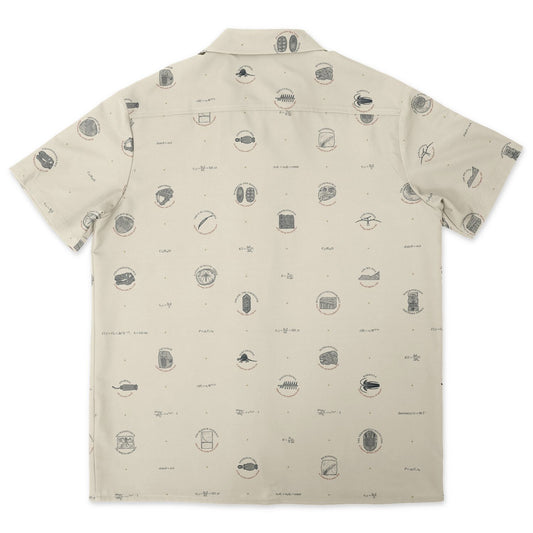
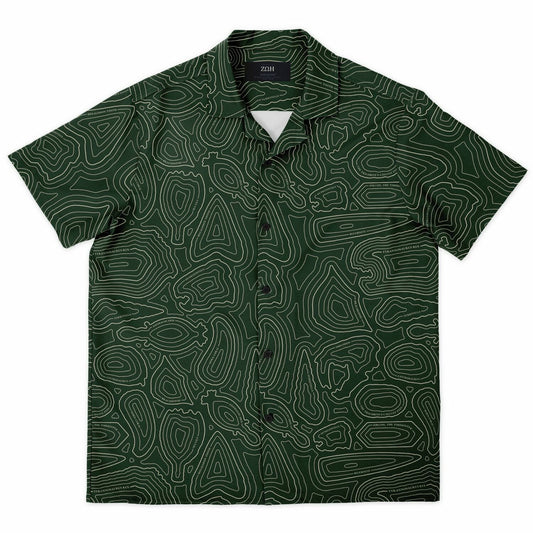
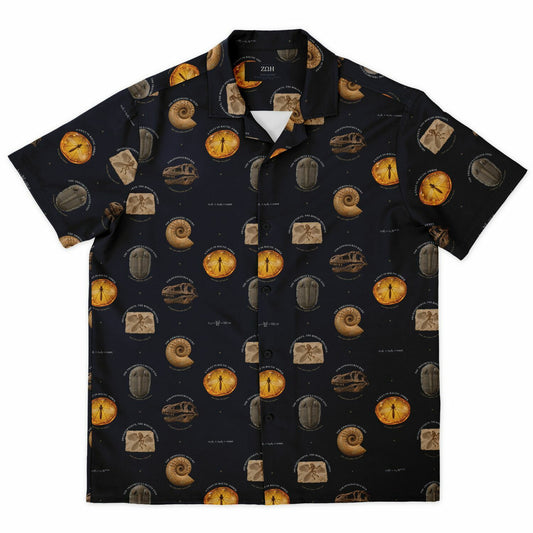
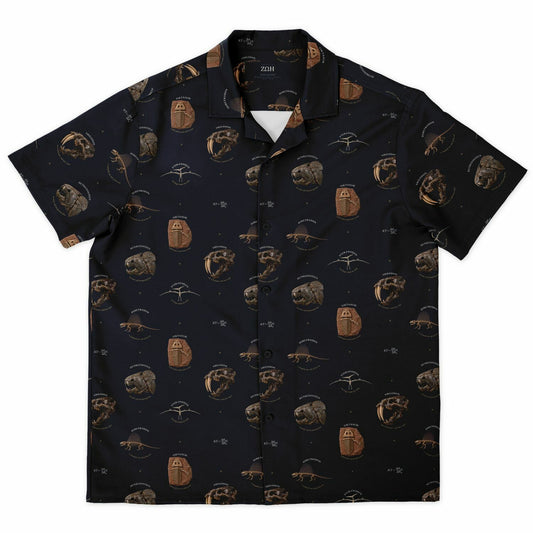
Digital mockup; photos of the finished piece are coming.
Dead Clade Walking Button-Up · Engraving · Smaller print
Dead Clade Walking Button-Up · Engraving · Smaller print
Five mass extinctions, the evidence they left, and who walked away.
One colorway: ink on cream.
Free U.S. shipping on every shirt.
Grand opening: the 10% is already taken off the price shown. Through 30 November.
| Inches | XS | S | M | L | XL | 2XL | 3XL | 4XL |
|---|---|---|---|---|---|---|---|---|
| Chest, flat | 20 | 21 | 22 | 23 | 24½ | 26¾ | 29 | 31¼ |
| Front length | 28½ | 29 | 29½ | 30 | 30¾ | 32 | 33 | 34 |
| Shoulder | 17¾ | 18¼ | 18¾ | 19¼ | 20 | 21⅛ | 22¼ | 23⅜ |
| Sleeve length | 8¼ | 8½ | 8¾ | 9 | 9¼ | 9⅝ | 10 | 10⅜ |
| cm | XS | S | M | L | XL | 2XL | 3XL | 4XL |
|---|---|---|---|---|---|---|---|---|
| Chest, flat | 50.8 | 53.3 | 55.9 | 58.4 | 62.2 | 67.9 | 73.7 | 79.4 |
| Front length | 72.4 | 73.7 | 74.9 | 76.2 | 78.1 | 81.3 | 83.8 | 86.4 |
| Shoulder | 45.1 | 46.4 | 47.6 | 48.9 | 50.8 | 53.7 | 56.5 | 59.4 |
| Sleeve length | 21.0 | 21.6 | 22.2 | 22.9 | 23.5 | 24.4 | 25.4 | 26.4 |
Measured with the shirt laid flat; chest is taken 1 in below the armhole, so double it for the full chest. The easiest check: lay a shirt that fits you flat and compare. Each shirt is cut and sewn by hand, so sizes can vary by up to 1 in. Stretch fabric (12% spandex).
Buying for someone? Compare a shirt they wear with this chart, or choose socks or a tie, which are one size. Or give a gift card and let them choose.
Still unsure? Ask us.
Couldn't load pickup availability
Also from Paleontology
-
The tieFossil Formal Medallion Tie · Amber Time Capsule
Regular price $36Sale price $32.40 -
The socksGilded Remains Socks · Concept Medallions · Carboniferous Night
Regular price $26Sale price $23.40


The story in the print
Dead clade walking is David Jablonski’s phrase, from 2002, for groups that survive a mass extinction only to fade afterwards. In 1982 David Raup and Jack Sepkoski counted marine animal families stage by stage and picked out five extinctions above the background: the end-Ordovician, Late Devonian, end-Permian, end-Triassic and end-Cretaceous, at 443, 372, 252, 201 and 66 million years ago on the International Commission on Stratigraphy’s chart, version 2024/12. The end-Permian was the worst by far, with estimates of species lost in the sea running from about 81 to 96 percent. In its aftermath Lystrosaurus, a tusked, beaked plant-eater, spread across southern Pangaea, and its fossils in Antarctica, found in 1969, helped show that the southern continents had once been joined.
The end of the Cretaceous left its evidence in a centimeter of clay. Walter Alvarez wanted to know how long the clay at Gubbio had taken to settle, and his father Luis suggested measuring iridium; with Frank Asaro and Helen Michel they found about thirty times the background, and in 1980 put the impactor at 10 ± 4 km across. In 1984 Bruce Bohor and colleagues found quartz grains in the boundary clay crossed by straight lamellae that no volcano makes, and in 1991 the Chicxulub crater, about 180 km across, was identified beneath the Yucatán. The idea of extinction began with teeth: in 1796 Georges Cuvier showed that the mammoth and the Ohio animal differed from both living elephants, and were gone.
The five images:
- Lystrosaurus: A Lystrosaurus skull from the Karoo: a short, deep head bent down into a beak, and two tusks, its only teeth.
- Shocked Quartz: One shocked quartz grain from the boundary clay under crossed polarizers, ruled by two straight sets of lamellae and a faint third.
- The Iridium Anomaly: A polished slab through the boundary at Gubbio, a gold line inlaid as the iridium graph: flat, a spike at the clay, a long tail.
- The Big Five: A fossil-packed limestone relief whose skyline is Sepkoski’s diversity curve, cut by five notches, the end-Permian by far the deepest.
- Mammoth and Mastodon: A woolly mammoth molar ridged with more than twenty enamel plates beside a mastodon molar studded with paired cusps.
This button-up carries DEAD CLADE WALKING at the smaller print scale. Each image is explained above. It is made for people who have prospected, jacketed and prepared fossils for a living or for a grade, and for anyone who likes to know what they are wearing.
Details: 88% polyester, 12% spandex stretch fabric, spread collar, short sleeves. Printed and sewn to order.
Fabric, care and how it’s made
- Fabric: 88% polyester, 12% spandex
- Fabric weight: 3.83 oz/yd² (130 g/m²)
- Care: machine wash cold, inside out. Do not bleach. Hang to dry. Iron on low.
- Made for adults.
- Made in USA of imported fabric.
- How it’s made: I design every template and check every figure; AI image tools help render the illustrations.
What’s on it The equations, ideas and images on this design, and what they mean
More from Paleontology
-
The Fossil Record Button-Up
Regular price $65Regular price$65Sale price $58.50 -
Strata Society Button-Up · Baize
Regular price $65Regular price$65Sale price $58.50 -
Taphonomy Button-Up · Midnight
Regular price $65Regular price$65Sale price $58.50 -
Not a Dinosaur Button-Up · Midnight
Regular price $65Regular price$65Sale price $58.50