Digital mockup; photos of the finished piece are coming.
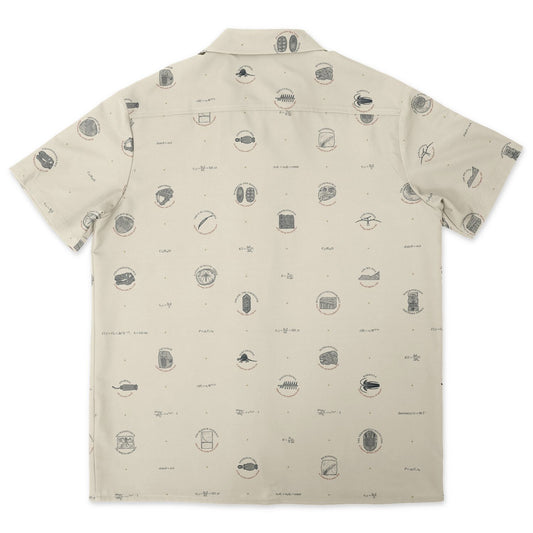
Taphonomy Button-Up · Engraving · Smaller print
Taphonomy Button-Up · Engraving · Smaller print
Five fossils everyone knows, each kept by a different trick of burial.
One colorway: ink on cream.
Free U.S. shipping on every shirt.
Grand opening: the 10% is already taken off the price shown. Through 30 November.
| Inches | XS | S | M | L | XL | 2XL | 3XL | 4XL |
|---|---|---|---|---|---|---|---|---|
| Chest, flat | 20 | 21 | 22 | 23 | 24½ | 26¾ | 29 | 31¼ |
| Front length | 28½ | 29 | 29½ | 30 | 30¾ | 32 | 33 | 34 |
| Shoulder | 17¾ | 18¼ | 18¾ | 19¼ | 20 | 21⅛ | 22¼ | 23⅜ |
| Sleeve length | 8¼ | 8½ | 8¾ | 9 | 9¼ | 9⅝ | 10 | 10⅜ |
| cm | XS | S | M | L | XL | 2XL | 3XL | 4XL |
|---|---|---|---|---|---|---|---|---|
| Chest, flat | 50.8 | 53.3 | 55.9 | 58.4 | 62.2 | 67.9 | 73.7 | 79.4 |
| Front length | 72.4 | 73.7 | 74.9 | 76.2 | 78.1 | 81.3 | 83.8 | 86.4 |
| Shoulder | 45.1 | 46.4 | 47.6 | 48.9 | 50.8 | 53.7 | 56.5 | 59.4 |
| Sleeve length | 21.0 | 21.6 | 22.2 | 22.9 | 23.5 | 24.4 | 25.4 | 26.4 |
Measured with the shirt laid flat; chest is taken 1 in below the armhole, so double it for the full chest. The easiest check: lay a shirt that fits you flat and compare. Each shirt is cut and sewn by hand, so sizes can vary by up to 1 in. Stretch fabric (12% spandex).
Buying for someone? Compare a shirt they wear with this chart, or choose socks or a tie, which are one size. Or give a gift card and let them choose.
Still unsure? Ask us.
Couldn't load pickup availability
Also from Paleontology
-
The tieFossil Formal Medallion Tie · Amber Time Capsule
Regular price $36Sale price $32.40 -
The socksGilded Remains Socks · Concept Medallions · Carboniferous Night
Regular price $26Sale price $23.40


The story in the print
Taphonomy is the study of how a living thing becomes a fossil, and each of these five famous specimens took a different road. The trilobite kept its own calcite, down to the lenses of its eyes. Each lens was a single crystal grown with its optical axis perpendicular to the surface, so light arriving head-on is not doubled by calcite’s double refraction, and in 1975 Euan Clarkson and Riccardo Levi-Setti showed that some are doublets whose inner surface follows the curves Descartes and Huygens worked out to remove spherical aberration. The ammonite’s shell dissolved, and the stone that filled its chambers shows the sutures: plain zigzags in the Paleozoic, frilled like ferns in the Jurassic and Cretaceous.
Archaeopteryx sank into the fine lime mud of a Jurassic lagoon at Solnhofen, feathers and all. The Berlin specimen, found in 1874 or 1875, was the first with a complete head, and Werner von Siemens paid 20,000 gold marks for it in 1880 so that Berlin could keep it. Barnum Brown dug the first Tyrannosaurus rex out of the Hell Creek Formation of Montana in 1902, its bones permineralized in the ground, and Henry Fairfield Osborn named it in 1905. The gnat was swallowed whole by the resin of an Eocene forest. Amber keeps bristles and wing veins, but not DNA, which breaks so fast that a 242-base stretch has a half-life of 521 years.
The five images:
- The Trilobite’s Calcite Eyes: Eldredgeops rana on gray Devonian shale: three lobes, eleven thoracic segments, and kidney-shaped eyes of separate calcite lenses in vertical files.
- The Ammonitic Suture: An ammonite’s polished internal mold, its sutures frilled like fern leaves and nesting along the coil, the body chamber left smooth.
- A Gnat in Baltic Amber: A fungus gnat in backlit Baltic amber: two wings, two halteres, star-shaped oak hairs, and a milky veil on one side.
- Archaeopteryx, the Berlin Specimen: The Berlin Archaeopteryx in pale Solnhofen limestone: head thrown back, teeth, three clawed fingers a hand and a long feathered bony tail.
- Tyrannosaurus rex: A Tyrannosaurus rex skull in side view: nostril, antorbital fenestra, keyhole eye socket, and four small D-shaped teeth at the front.
This button-up carries TAPHONOMY at the smaller print scale. Each image is explained above. It is made for people who have prospected, jacketed and prepared fossils for a living or for a grade, and for anyone who likes to know what they are wearing.
Details: 88% polyester, 12% spandex stretch fabric, spread collar, short sleeves. Printed and sewn to order.
Fabric, care and how it’s made
- Fabric: 88% polyester, 12% spandex
- Fabric weight: 3.83 oz/yd² (130 g/m²)
- Care: machine wash cold, inside out. Do not bleach. Hang to dry. Iron on low.
- Made for adults.
- Made in USA of imported fabric.
- How it’s made: I design every template and check every figure; AI image tools help render the illustrations.
What’s on it The equations, ideas and images on this design, and what they mean
More from Paleontology
-
The Fossil Record Button-Up
Regular price $65Regular price$65Sale price $58.50 -
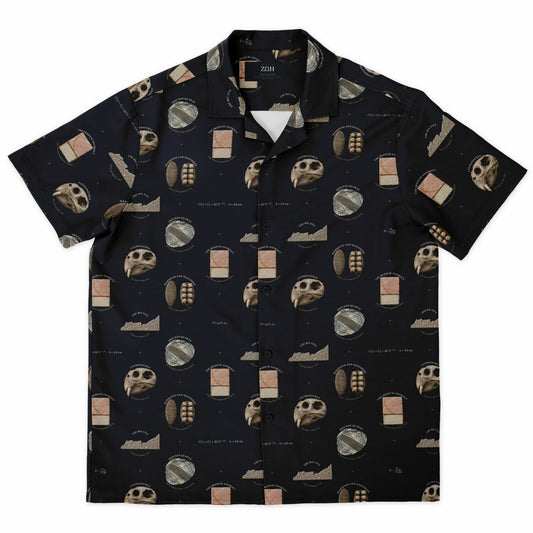
Strata Society Button-Up · Baize
Regular price $65Regular price$65Sale price $58.50 -
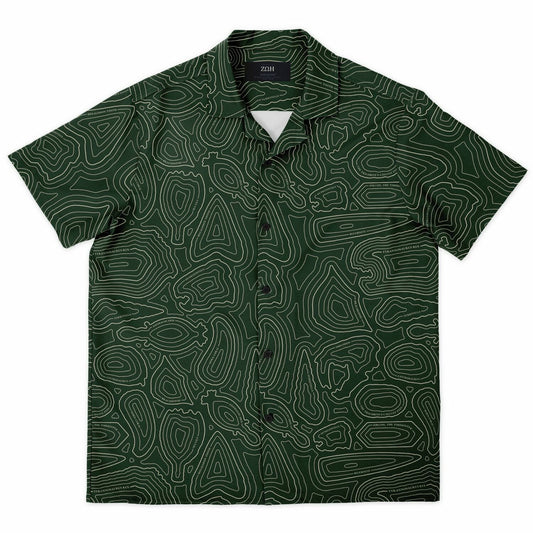
Dead Clade Walking Button-Up · Midnight
Regular price $65Regular price$65Sale price $58.50 -
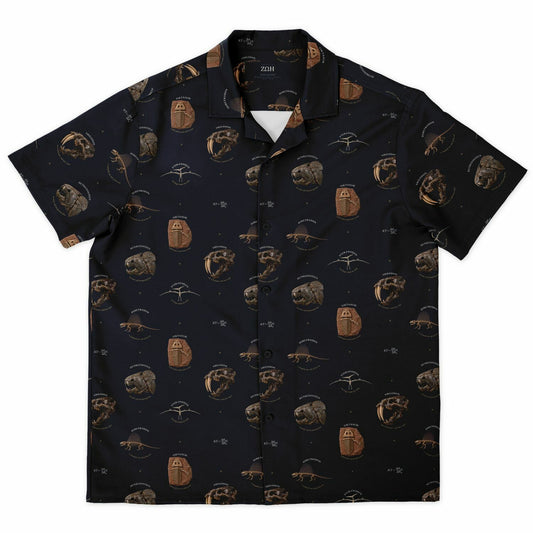
Not a Dinosaur Button-Up · Midnight
Regular price $65Regular price$65Sale price $58.50